
 简体中文版

Instead of shaping the entire plate in a single operation, JCOE gradually bends the steel plate through a series of controlled pressing operations. After the plate is formed into an open pipe section, the longitudinal edges are welded together, followed by mechanical expansion to achieve the specified pipe diameter and dimensional accuracy.
Before forming, the steel plate is prepared for the longitudinal weld. Edge milling creates the required weld bevel, while pre-bending helps form the plate edges to the required curvature and reduces flat areas near the longitudinal seam.
(1) J-Forming
The steel plate is progressively pressed from one side toward the center, creating a curved section that resembles the letter J.
(2) C-Forming
The forming operation continues on the remaining section of the plate until the plate develops a broader curved profile resembling the letter C. Progressive pressing distributes the deformation along the plate rather than forming the entire cross-section in one stroke.
(3) O-Forming
The plate is pressed further until the two longitudinal edges are brought together, creating an approximately circular O-shaped pipe section with an open longitudinal seam.
(4) Expansion
After longitudinal seam welding, the pipe undergoes mechanical expansion to achieve the specified outside diameter, roundness and dimensional tolerances.
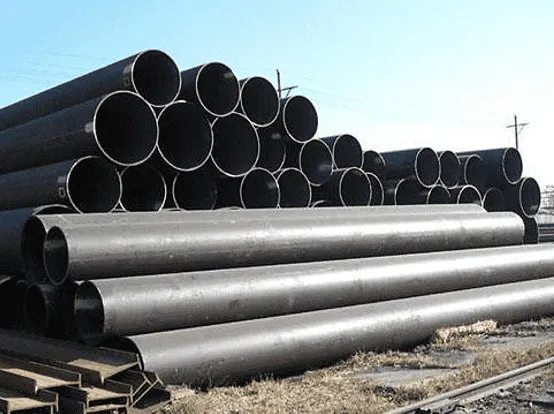
JCOE forming is commonly used for LSAW steel pipes requiring large diameters, heavy wall thicknesses, or varied pipe dimensions.
JCOE forming is suitable for manufacturing large-diameter, heavy-wall LSAW steel pipes. The progressive pressing sequence distributes plate deformation across multiple forming operations, making the process suitable for pipe dimensions that require substantial forming capacity.
Huaxi's published JCOE range covers outside diameters from 406 to 1626 mm and wall thicknesses from 6 to 75 mm.
JCOE forming can accommodate different combinations of outside diameter and wall thickness by adjusting the forming sequence and parameters.
JCOE and UOE are both used to manufacture LSAW steel pipes, but their forming sequences and production characteristics are different.
| Parameter | JCOE Forming | UOE Forming |
|---|---|---|
| Forming sequence | J-forming → C-forming → O-forming → Expansion | U-forming → O-forming → Expansion |
| Forming principle | Progressive plate bending through multiple forming operations | U-forming followed by O-forming with dedicated forming tooling |
| Specification flexibility | Well suited to varied pipe dimensions | Well suited to standardized production ranges |
Huaxi Steel manufactures JCOE-formed LSAW steel pipes for project requirements involving large diameters and heavy wall thicknesses. Available dimensions and specifications depend on the production equipment, steel grade and applicable manufacturing standard.
| Parameter | JCOE LSAW Pipe |
|---|---|
| Outside Diameter | 406–1626 mm |
| Wall Thickness | 6–75 mm |
| Standard Length | 3–12.5 m |
| Forming Method | JCOE |
JCOE-formed LSAW steel pipes are used for large-diameter and heavy-wall pipe applications, including:
- Oil and gas transmission pipelines
- Water transmission systems
- Structural and piling projects
- Offshore structures
- Industrial infrastructure
What does JCOE stand for?
JCOE refers to J-forming, C-forming, O-forming and Expansion, the main stages used to form LSAW steel pipes.
How does JCOE forming work?
JCOE forms the steel plate progressively through J-forming, C-forming and O-forming, followed by mechanical expansion to achieve the specified pipe dimensions.

Address:1177 Huanhu Road, Yuelu District, Changsha, Hunan, China
 WhatsApp
 WeChat