
 简体中文版
简体中文版

Both processes produce high-quality LSAW steel pipes. UOE is generally selected for standardized, high-volume production, while JCOE is preferred when larger diameters or custom specifications are required.
| If your project requires... | Recommended Forming Method |
|---|---|
| Large-volume pipeline production | UOE |
| Custom pipe dimensions | JCOE |
| Higher production efficiency | UOE |
| Large-diameter or thick-wall pipes | JCOE |
| Offshore transmission pipelines | UOE |
| Structural and piling projects | JCOE |
| Lower equipment investment | JCOE |
| Better dimensional consistency | UOE |
In general, UOE is preferred for standardized, high-volume pipeline production, while JCOE offers greater flexibility for large diameters and customized projects.
|
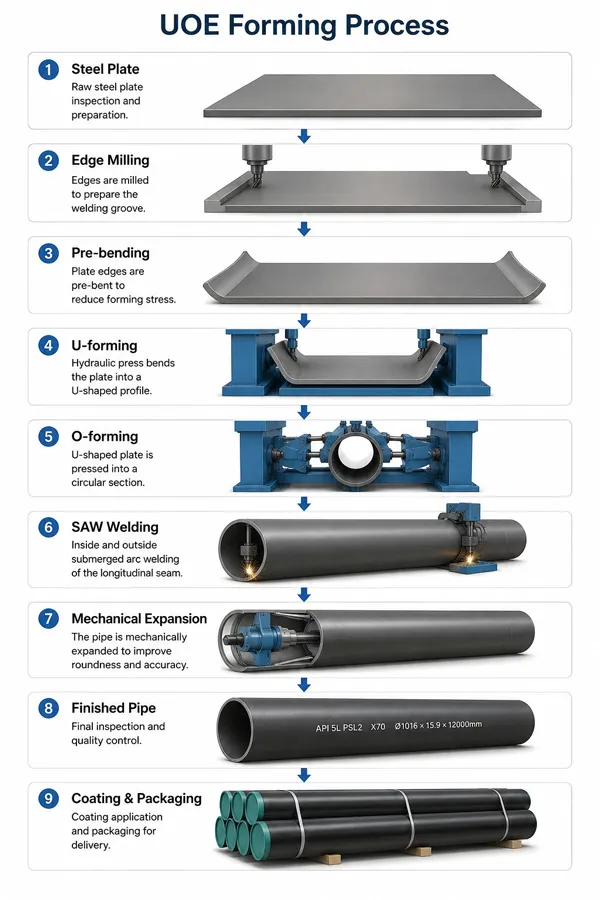
UOE is a forming process widely used for manufacturing standard-size LSAW steel pipes in large production volumes. The process consists of U-forming, O-forming, submerged arc welding (SAW), and mechanical expansion. After forming, the pipe is welded using submerged arc welding (SAW) and expanded to achieve the required diameter and geometric accuracy.
The plate edges are milled to prepare the welding bevel and pre-bent before forming. Step 2. U-forming A hydraulic press bends the steel plate into a U-shaped profile. Step 3. O-forming The U-shaped plate is further pressed into a closed circular section. Step 4. Internal and External SAW Welding The longitudinal seam is welded using submerged arc welding from both the inside and outside. Step 5. Mechanical Expansion Mechanical expansion corrects pipe roundness, improves dimensional accuracy, and reduces residual forming stress. UOE is best suited for large-volume production of standard-size LSAW pipes used in oil and gas transmission projects. |
 |
|
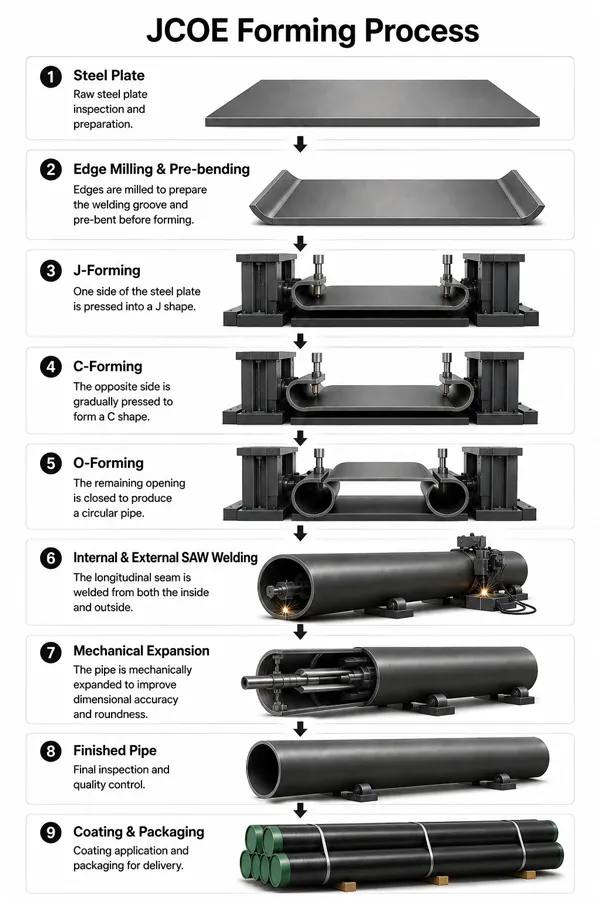
JCOE is a multi-step press-forming process used to manufacture large-diameter and custom-size LSAW steel pipes.Unlike UOE, JCOE forms the pipe through multiple pressing steps instead of two major forming operations. This provides greater flexibility in pipe diameter and wall thickness.
Step 1. Edge Preparation The plate edges are machined and pre-bent before forming.
Step 2. J-Forming One side of the steel plate is pressed into a J shape.
Step 3. C-Forming The opposite side is gradually pressed to form a C shape.
Step 4. O-Forming The remaining opening is closed to produce a circular pipe.
Step 5. Internal and External SAW Welding The longitudinal seam is welded from both the inside and outside.
Step 6. Mechanical Expansion Mechanical expansion improves roundness and dimensional consistency before final inspection. JCOE is preferred for large-diameter, heavy-wall, and custom-size LSAW pipes used in structural, offshore, and project-specific applications. |
 |
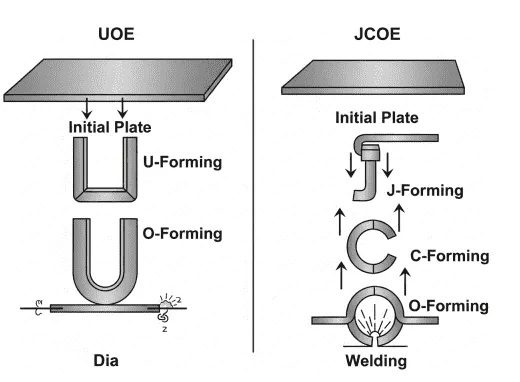
The table below summarizes the main differences between the UOE and JCOE forming processes.
| Item | UOE | JCOE |
|---|---|---|
| Forming Sequence | U → O → Mechanical Expansion | J → C → O → Mechanical Expansion |
| Forming Method | Two-stage press forming | Progressive multi-step press forming |
| Production Efficiency | Higher; optimized for continuous production | Lower; multiple pressing operations required |
| Equipment Investment | Higher due to dedicated U- and O-forming presses | Lower with fewer dedicated forming tools |
| Available Size Range | Best suited for standard pipe sizes | Supports larger diameters and custom dimensions |
| Maximum Wall Thickness | Up to approximately 25.4 mm | Up to approximately 75 mm |
| Dimensional Consistency | Excellent after mechanical expansion | Good; depends on forming accuracy and expansion |
| Production Flexibility | Efficient for repeat production of the same specification | Easier to switch between different diameters and wall thicknesses |
| Typical Applications | Oil & gas transmission, cross-country pipelines, subsea pipelines | Structural projects, pipe piling, offshore structures, customized pipelines |
Typical manufacturing capabilities vary by equipment configuration, but the ranges below represent the most common specifications for UOE and JCOE LSAW steel pipes.
| Specification | UOE LSAW Pipe | JCOE LSAW Pipe |
|---|---|---|
| Outside Diameter | 508–1118 mm (20–44 in) | 406–1626 mm (16–64 in) |
| Wall Thickness | 6.0–25.4 mm | 6.0–75 mm |
| Standard Length | 9–12.3 m | 3–12.5 m |
| Steel Grades | API 5L Grade A–X90 | API 5L Grade A–X100 |
| Typical Standards | API 5L, ISO, ASTM, EN, DNV | API 5L, ISO, ASTM, EN, DNV |
UOE achieves high production efficiency because each pipe is formed with dedicated U and O presses. Once the production line is set up, the same specification can be manufactured continuously with minimal adjustment.
Mechanical expansion further improves roundness and dimensional consistency, which is why UOE is widely used for long-distance oil and gas transmission pipelines.
The limitation is manufacturing flexibility. Each production line is designed for a relatively fixed size range, so changing diameter or wall thickness is less economical than with JCOE.
JCOE uses progressive step-by-step forming instead of dedicated forming dies. The same production line can manufacture a wider range of diameters and heavier wall thicknesses with fewer tooling changes.
Because the pipe is formed progressively, changing diameter or wall thickness requires fewer tooling adjustments than UOE.
The following table provides a quick selection guide.
| Project Requirement | UOE | JCOE |
|---|---|---|
| Large-volume production | ✓ | |
| Small-batch or project-based production | ✓ | |
| Standard pipe dimensions | ✓ | |
| Custom OD or wall thickness | ✓ | |
| Large-diameter or heavy-wall pipe | ✓ | |
| High dimensional consistency | ✓ | |
| Lower unit cost for large orders | ✓ | |
| Repeat production of the same specification | ✓ | |
| Lower tooling cost for customized orders | ✓ | |
| API 5L line pipe production | ✓ | |
| Customized project specifications | ✓ |
Q1. What is the difference between UOE and JCOE forming?
UOE forms the pipe through U-forming, O-forming, and mechanical expansion, making it ideal for high-volume production of standard pipe sizes. JCOE uses progressive J-, C-, and O-forming, allowing greater flexibility for large diameters, heavy walls, and custom specifications.
Q2. Which is better, UOE or JCOE?
Neither process is better in every situation. UOE is preferred for large production runs of standard sizes, while JCOE is better suited for custom dimensions, heavy-wall pipes, and smaller production batches.
Q3. Can UOE and JCOE pipes both meet API 5L?
Yes. Both UOE and JCOE LSAW steel pipes can be manufactured to API 5L and other international standards. The choice of forming process does not determine standard compliance.
Q4. Why is JCOE preferred for large-diameter pipes?
JCOE uses progressive forming instead of dedicated U and O dies, making it easier to manufacture larger diameters and heavier wall thicknesses with the same production line.
Q5. Why is mechanical expansion used in both UOE and JCOE?
Mechanical expansion improves pipe roundness, dimensional consistency, and residual stress distribution after welding. It helps the finished pipe meet dimensional tolerance requirements specified by applicable standards.

Address:1177 Huanhu Road, Yuelu District, Changsha, Hunan, China
 WhatsApp
 WeChat