
 简体中文版
简体中文版

ERW, LSAW, and SSAW are the three principal welded steel pipe manufacturing methods used in oil and gas, water transmission, structural, and infrastructure projects. Although these products may be manufactured to the same standards, significant differences exist in weld configuration, diameter capability, pressure performance, and manufacturing cost.
The comparison below outlines the key differences between ERW, LSAW, and SSAW pipes and provides guidance on selecting the most suitable pipe type for different engineering applications.
The table below summarizes the key differences between ERW, LSAW, and SSAW steel pipes in terms of manufacturing method, dimensional range, performance characteristics, and typical applications.
| Item | ERW Pipe | LSAW Pipe | SSAW Pipe |
|---|---|---|---|
| Manufacturing Method | High-Frequency Electric Resistance Welding (HFW) | Longitudinal Submerged Arc Welding | Spiral Submerged Arc Welding |
| Raw Material | Hot-Rolled Steel Coil | Steel Plate | Hot-Rolled Steel Coil |
| Weld Configuration | Longitudinal Seam | Longitudinal Seam | Helical (Spiral) Seam |
| Typical OD Range | 21.3–660 mm | 406–1500 mm | 219–3500 mm |
| Typical Wall Thickness | 2–20 mm | 6–80 mm | 5–25 mm |
| Dimensional Accuracy | High | High | Moderate |
| Weld Length | Short | Short | Longest |
| Pressure Capability | Medium to High | High | Medium |
| Large Diameter Capability | Limited | Good | Excellent |
| Material Utilization | High | Moderate | High |
| Manufacturing Cost | Lowest | Highest | Moderate |
| Typical Applications | Structural Pipe, Water Line, Gas Distribution | Oil & Gas Transmission, Offshore Pipelines | Water Transmission, Piling, Infrastructure Projects |
Typical Applications Structural Pipe, Water Line, Gas Distribution Oil & Gas Transmission, Offshore Pipelines Water Transmission, Piling, Infrastructure Projects
The primary differences between ERW, LSAW, and SSAW pipes lie in the welding method and weld configuration.
| Pipe Type | Welding Method | Weld Configuration |
|---|---|---|
| ERW | High-Frequency Electric Resistance Welding (HFW) | Longitudinal Seam |
| LSAW | Longitudinal Submerged Arc Welding (LSAW) | Longitudinal Seam |
| SSAW | Spiral Submerged Arc Welding (SSAW) | Spiral Seam |
ERW uses resistance welding, while LSAW and SSAW use submerged arc welding. The key difference between LSAW and SSAW is weld orientation: longitudinal versus spiral.
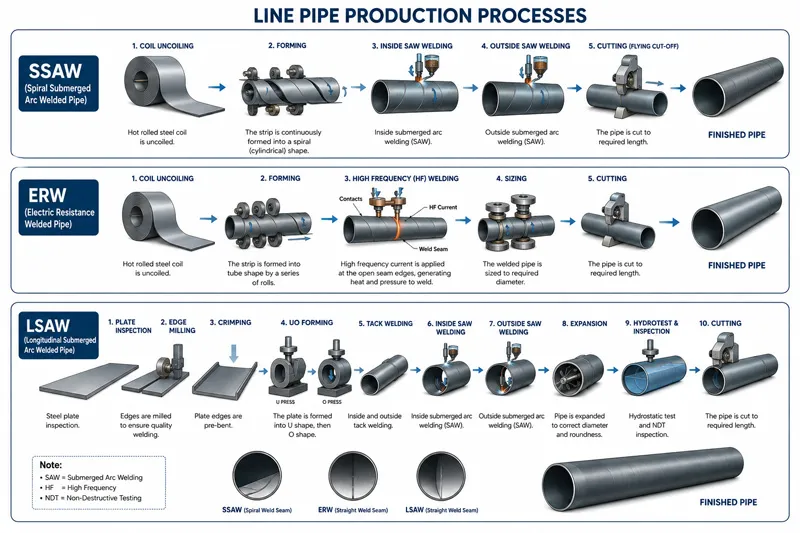
Available diameter range is one of the main factors influencing pipe selection.
| Pipe Type | Typical OD Range |
|---|---|
| ERW | 21.3–660 mm |
| LSAW | 406–1500 mm |
| SSAW | 219–3500 mm |
ERW steel pipes are generally limited to small and medium diameters. LSAW steel pipes are commonly used for medium- and large-diameter transmission pipelines, while SSAW pipes provide the broadest size range and are frequently selected for large-diameter water transmission, piling, and infrastructure projects.
In terms of pressure performance, the general relationship is:
LSAW > ERW > SSAW
LSAW generally offers the highest pressure capability among the three welded pipe types due to its short weld seam and ability to accommodate thick wall sections. ERW is widely used in medium- and high-pressure service, while SSAW is more commonly specified for lower-pressure transmission systems and structural applications.
In most cases, manufacturing cost follows the order:
ERW < SSAW < LSAW
ERW benefits from continuous coil-based production, while LSAW requires steel plate forming and more complex welding operations. SSAW generally falls between the two in terms of manufacturing cost.
| Application | Recommended Pipe Type |
|---|---|
| Long-Distance Oil & Gas Pipelines | LSAW |
| High-Pressure Service | LSAW |
| Large-Diameter Water Transmission | SSAW |
| Bridge Piles | SSAW |
| Marine Piles | SSAW |
| Building Structures | ERW |
| Mechanical Structures | ERW |
| Budget-Sensitive Projects | ERW |
Recommended: LSAW Pipe
LSAW pipes are commonly specified for long-distance oil and gas transmission projects due to their high pressure capability, thick wall availability, and excellent dimensional consistency. They are widely used in API 5L PSL2 pipeline systems where reliability and weld integrity are critical.
For lower-pressure gathering lines or smaller-diameter distribution systems, ERW pipe may also be used depending on project specifications.
Recommended: SSAW Pipe
SSAW pipes are frequently used for large-diameter water transmission systems because they offer a wide diameter range and competitive manufacturing cost. Municipal water projects, irrigation systems, and regional water transfer pipelines commonly utilize SSAW pipe where large volumes of water must be transported economically.
For projects involving higher operating pressures or stricter dimensional requirements, LSAW pipe may also be considered.
Recommended: ERW Pipe
ERW pipe is widely used in structural applications due to its dimensional accuracy, smooth surface quality, and cost efficiency. Common applications include steel structures, mechanical tubing, columns, supports, fencing, and general construction projects.
Where larger diameters are required, SSAW pipe may also be used for structural purposes.
Recommended: SSAW Pipe
SSAW pipe is one of the most common choices for bridge piles, marine piles, port construction, and foundation engineering. Its ability to produce large diameters economically makes it particularly suitable for projects where axial load capacity is a primary design consideration.
Recommended: LSAW Pipe
For demanding operating conditions involving high pressure, thick wall sections, or critical transmission infrastructure, LSAW pipe is generally preferred. Its manufacturing process, weld configuration, and dimensional control make it a common specification for major oil, gas, and offshore pipeline projects.
Recommended: ERW Pipe
When project economics are a primary consideration, ERW pipe often provides the most cost-effective solution. For many water, gas distribution, structural, and mechanical applications, ERW pipe offers an excellent balance between performance and manufacturing cost.
Q1: Is LSAW stronger than SSAW pipe?
In general, LSAW pipe is preferred for high-pressure applications due to its shorter weld seam and ability to accommodate thicker wall sections. However, actual pipe strength also depends on steel grade, wall thickness, and manufacturing quality.
Q2: What is the difference between LSAW and SSAW pipe?
LSAW pipe uses a straight longitudinal weld, while SSAW pipe uses a spiral weld. LSAW is typically preferred for high-pressure transmission systems, whereas SSAW is commonly selected for large-diameter water transmission and piling applications.
Q3: Why is LSAW pipe more expensive than SSAW pipe?
LSAW pipe is manufactured from steel plate and requires more complex forming and welding processes. SSAW pipe is produced from steel coil with higher material utilization, resulting in lower manufacturing costs.
Q4: What is the difference between ERW and LSAW pipe?
The main differences are manufacturing method, diameter range, wall thickness capability, and typical applications. ERW pipe is commonly used for smaller diameters, while LSAW pipe is often selected for large-diameter, high-pressure transmission systems.
Q5: Which pipe is best for long-distance oil and gas transmission?
LSAW pipe is generally considered the preferred option for long-distance oil and gas pipelines because of its pressure capability, dimensional consistency, and suitability for thick-wall applications.

Address:1177 Huanhu Road, Yuelu District, Changsha, Hunan, China
 WhatsApp
 WeChat