
 简体中文版
简体中文版

SSAW pipe (Spiral Submerged Arc Welded Pipe) standards depend on the intended service and application. API 5L is commonly specified for oil and gas line pipe, ASTM A252 covers steel pipe piles, while EN standards such as EN 10217-5 and EN 10219-1 address pressure and structural applications. The applicable standard defines the required grade, chemical composition, dimensions, and testing requirements.
| Standard | Scope & Application | Typical SSAW Pipe Use |
|---|---|---|
| API 5L | Oil & Gas Transmission | Long-distance oil and gas pipelines |
| ASTM A252 | Foundation & Structural Piling | Pipe piles and cast-in-place concrete pile shells |
| ASTM A139 | Liquid Conveying | Water, liquid, gas and vapor conveying |
| EN 10217-5 | Pressure Applications | Pressure piping and high-temperature fluid service |
| EN 10219-1 | Structural Applications | Structural hollow sections and load-bearing structures |
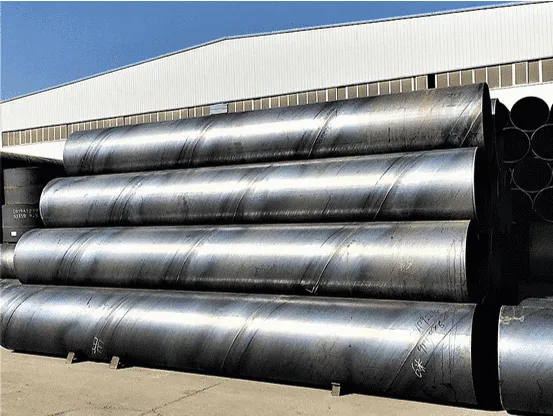
API 5L covers line pipe for oil and gas transmission and defines two Product Specification Levels, PSL1 and PSL2. PSL2 has additional requirements for chemical composition, mechanical properties, inspection, testing, and documentation. The applicable level depends on the project specification.
For a detailed comparison of the two levels, see our guide to API 5L PSL1 vs. PSL2.
Common API 5L grades for SSAW line pipe include Grade B, X42, X52, X60, X65, and X70. Higher-strength grades provide higher specified minimum yield strength, while the final grade selection depends on pipe dimensions, design conditions, operating service, and project requirements.
| API 5L Grade | Specified Minimum Yield Strength |
|---|---|
| Grade B | 245 MPa (35,500 psi) |
| X42 | 290 MPa (42,100 psi) |
| X52 | 360 MPa (52,200 psi) |
| X60 | 415 MPa (60,200 psi) |
| X65 | 450 MPa (65,300 psi) |
| X70 | 485 MPa (70,300 psi) |
Other API 5L grades are also specified depending on the applicable PSL and project requirements.
API 5L SSAW pipe is inspected for pipe body properties, spiral weld integrity, dimensions, and pressure tightness. Typical quality checks include:
Chemical analysis: Verification of specified chemical elements against the requirements for the selected grade.
Tensile testing: Verification of yield strength, tensile strength, and elongation.
Hydrostatic testing: Pressure testing to verify pressure tightness.
Weld-seam NDT: Ultrasonic or other specified non-destructive testing to detect discontinuities in the spiral weld.
Dimensional inspection: Verification of outside diameter, wall thickness, length, straightness, and other specified dimensions.
Visual and surface inspection: Examination of the pipe surface and weld for visible defects.
Pipe piles for deep foundations, marine structures, bridge foundations, and retaining structures
| ASTM A252 Grade | Min. Yield Strength | Min. Tensile Strength |
|---|---|---|
| Grade 1 | 30,000 psi (205 MPa) | 45,000 psi (310 MPa) |
| Grade 2 | 35,000 psi (240 MPa) | 60,000 psi (415 MPa) |
| Grade 3 | 45,000 psi (310 MPa) | 66,000 psi (455 MPa) |
ASTM A139 covers electric-fusion (arc)-welded steel pipe with straight or spiral seams in NPS 4 and larger, making it directly applicable to SSAW pipe for liquid, gas, and vapor conveying.
ASTM A53 does not cover spiral-welded SSAW pipe; its welded pipe types are Type F and Type E, while Type S is seamless.
EN 10217-5 covers submerged arc welded tubes for pressure applications, including SAWH (submerged arc helical welded) tubes with specified elevated-temperature properties. The standard covers non-alloy and alloy steel grades for pressure service.
EN 10219-1 covers cold-formed welded structural hollow sections, with commonly specified grades including S235JRH, S275J2H, and S355J2H. The designation also reflects impact toughness requirements at specified temperatures, such as 20°C for S235JRH and −20°C for S275J2H and S355J2H.
| Primary Project Application | Applicable Standard | Typical Service |
|---|---|---|
| Oil & Gas Transmission | API 5L | Oil and gas transmission |
| Foundation Piling & Marine Structures | ASTM A252 | Load-bearing pipe piles |
| Liquid Conveying | ASTM A139 | Water, gas, and other liquid-conveying services |
| Pressure & Elevated-Temperature Applications | EN 10217-5 | Pressure piping and high-temperature fluid service |
| Structural Hollow Sections | EN 10219-1 | Load-bearing structural applications |
Q: What standards are used for SSAW steel pipe?
A: There is no single standard for SSAW pipe. API 5L is used for oil and gas transmission, ASTM A252 for pipe piling, ASTM A139 for liquid conveying, and EN 10217-5 and EN 10219-1 for pressure and structural applications.
Q: Is API 5L applicable to SSAW pipe?
A: Yes. API 5L covers welded line pipe, including SSAW pipe. The applicable grade, PSL, and testing requirements depend on the project specification.
Q: Does ASTM A53 cover SSAW pipe?
A: No. ASTM A53 does not cover spiral-welded SSAW pipe. ASTM A139 is the more directly applicable ASTM standard for spiral-welded pipe used in liquid-conveying service.

Address:1177 Huanhu Road, Yuelu District, Changsha, Hunan, China
 WhatsApp
 WeChat