
 简体中文版
简体中文版

In the modern steel pipe manufacturing industry, welded steel pipes are widely used in oil and gas transportation, structural engineering, energy pipelines, and municipal engineering due to their cost advantages, wide range of specifications, and high production efficiency.
Currently, the three most common industrial methods for producing welded steel pipes are:
These three pipes differ significantly in raw materials, welding methods, size ranges, and application areas.
LSAW pipes, also known as SAW pipes, are made from steel plates, formed by a forming machine, and then subjected to double-sided submerged arc welding. This process gives LSAW steel pipes excellent ductility, weld toughness, uniformity, plasticity, and good sealing properties.
LSAW steel pipes typically employ two main forming processes:
UOE Forming Process (U-ing → O-ing → Expanding)
JCOE Forming Process
Ultrasonic testing of steel plate → Edge milling → Edge crimping → Forming (UOE or JCOE) → Inside SAW → Outside SAW → Mechanical Expanding → Non-destructive testing (UT / RT / Hydrostatic Test).
Stable weld quality and low defect rate;
High weld toughness, suitable for high-strength pipelines;
High dimensional accuracy and good roundness;
Suitable for high-pressure transmission pipelines.
Due to the use of steel plates, LSAW steel pipes can be produced with thicker walls and larger diameters, making them one of the main pipe materials for long-distance oil and gas transmission pipelines.
The diameter range is larger than ERW pipe, typically 16 inches to 60 inches (406 mm to 1500 mm).
Outer Diameter (OD): 406 – 1500 mm (16" – 60")
Wall Thickness (WT): 8 – 80 mm
Length: 6 – 12.2 m
API 5L (PSL1 / PSL2)
ASTM A252
ASTM A53
EN 10219
EN 10210
Long-distance oil and gas pipelines;
Submarine pipelines;
High-pressure water pipelines;
Bridge structures and large steel structures.
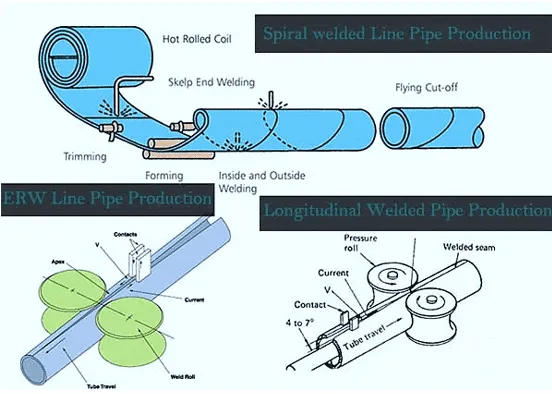
SSAW pipe, also known as spiral submerged arc welded pipe (HSAW pipe), has a spiral weld. It uses the same submerged arc welding technology as longitudinal submerged arc welded pipe (LSAW pipe). The difference lies in the welding process: SSAW pipes use spiral welding, while LSAW pipes use longitudinal welding.
Steel strip is rolled at an angle to the pipe's center, then formed and welded, resulting in a spiral weld.
Coil uncoiling → Trimming → Spiral forming → Internal submerged arc welding → External submerged arc welding → Non-destructive testing → Hydrostatic testing.
Capable of producing ultra-large diameter pipes;
High raw material utilization rate;
Lower cost than LSAW pipes;
Suitable for medium and low pressure pipelines.
It should be noted that due to the spiral weld and its longer length, LSAW pipes are generally preferred for high-pressure pipelines. Its advantage lies in the ability to produce SSAW pipes of different diameters using the same size steel strip, offering a wide range of raw material options. Furthermore, the weld should avoid initial stress and possess good load-bearing capacity.
SSAW pipe diameters range from 20 inches to 100 inches (406 mm to 2540 mm).
Outer Diameter (OD): 219 – 3500 mm
Wall Thickness (WT): 5 – 25 mm
Length: 6 – 12 m
Urban water supply pipelines;
Natural gas transmission pipelines;
Bridge pile foundations;
Marine engineering pile pipes.
ERW steel pipe is made from hot-rolled steel coils as raw material, continuously formed and then welded using high-frequency resistance welding (HFW). ERW welding does not use filler metal; instead, it utilizes the resistance heat generated by current passing through the edges of the steel plate to fuse the metal.
ERW pipe is manufactured from steel coils: First, the steel coil is unrolled, ground, and cut. Finally, the two ends are connected by high-frequency electric welding (HFI and HFW) to form a pipe shape.
High production efficiency;
Low cost;
Good surface quality;
High dimensional accuracy.
With the development of high-frequency welding technology, ERW steel pipes have gradually replaced seamless steel pipes in some medium and low-pressure pipeline applications due to their price and performance advantages.
ERW pipe sizes range from ½ inch to 20 inches (12 mm to 508 mm)
Wall thickness (WT): 2 – 20 mm
Length: 6 – 12 m
ASTM A53
ASTM A500
API 5L
EN 10219
Building structural pipes;
Mechanical structural pipes;
Water and gas pipelines;
Scaffolding steel pipes.
|
Abbreviations |
ERW |
LSAW |
SSAW |
|
Name |
Electric Resistance Welded pipe |
Longitudinal Submerged Arc Welding pipe |
Spiral Submerged Arc Welding pipe |
|
Raw Material |
steel coil |
steel plate |
steel coil |
|
Technique |
resistance welding |
submerged arc welding |
submerged arc welding |
|
Appearance |
Longitudinal weld seam, weld seam not visible |
Longitudinal weld seam |
Spiral weld seam |
|
Prices |
cheaply |
high |
cheaply |
|
Specificities |
Small diameter thin wall steel pipe |
Large diameter thick wall steel pipe |
Extra large diameter steel pipe |
|
Appliance |
For low-pressure fluid transfer, such as water, gas, air, and steam piping |
Mainly used in long-distance pipelines for the transmission of oil, natural gas, or water |
Mainly used for low-pressure fluid transportation, such as water and gas pipelines, as well as for building structures and bridge elements |
In practical engineering, the choice of steel pipe type typically depends on the following factors:
For small diameters (≤ 660 mm), ERW steel pipes are chosen. They are continuously formed from steel coils, high-frequency welded, resulting in high production efficiency, good dimensional accuracy, and low cost, such as API 5L Gr.B ERW.
For medium to large diameters (406 – 1500 mm), LSAW steel pipes are chosen. They are made from steel plates, offering high strength, stable weld quality, and suitability for high-pressure transportation, such as API 5L X65 LSAW.
For extra-large diameters (≥ 508 mm), SSAW steel pipes are chosen. They are spirally formed, allowing for the production of extra-large diameter pipes, and offer high material utilization, such as API 5L X52 SSAW.
Low Pressure: ERW/SSAW steel pipes are low-cost and meet general transportation needs.
Medium Pressure: ERW/LSAW steel pipes offer moderate strength and high reliability.
High Pressure: LSAW steel pipes have short welds and high strength, making them suitable for long-distance oil and gas pipelines.
ERW steel pipes have high production efficiency, resulting in lower prices.
SSAW steel pipes have high raw material utilization.
LSAW steel pipes have complex production processes, resulting in higher prices.
Therefore, cost-sensitive applications may choose ERW/SSAW steel pipes, while non-cost-sensitive applications may choose LSAW steel pipes.
In many low- or medium-pressure applications, ERW steel pipes can replace seamless steel pipes, such as water pipelines, structural pipes, and mechanical pipes. However, in high-temperature, high-pressure, or critical equipment, seamless steel pipes remain more reliable.
SSAW steel pipes utilize a spiral forming process, allowing the production of large-diameter steel pipes of varying diameters using narrower steel strips. This results in flexible production, lower costs, and makes them ideal for large-diameter water pipelines and foundation engineering.
ERW, LSAW, and SSAW are the three most important welding processes in modern steel pipe manufacturing:
ERW steel pipes is suitable for small-diameter, thin-walled structures and low-pressure pipelines;
LSAW steel pipes is suitable for high-strength, large-diameter oil and gas pipelines;
SSAW steel pipes is suitable for ultra-large diameter water transmission and infrastructure projects.

Address:1177 Huanhu Road, Yuelu District, Changsha, Hunan, China
 WhatsApp
 WeChat