
 简体中文版
简体中文版

LSAW steel pipes are crucial for transporting hydrocarbons under extreme conditions, thus requiring stringent mechanical and metallurgical properties. The JCOE forming process is a leading manufacturing technology due to its flexibility in handling high-strength, thick-walled pipes (typically 6-40 mm wall thickness and 16-60 inch diameter).
Unlike the UOE method (which relies on simultaneous forming in a U-shaped press followed by O-forming and flaring), JCOE employs a progressive, step-by-step forming method, reducing springback and residual stress.
This paper systematically evaluates the JCOE process for LSAW steel pipes by analyzing key parameters such as forming force, strain distribution, weld quality, and post-forming mechanical properties. Furthermore, it compares and evaluates JCOE with UOE and three-roll bending methods to highlight the advantages and limitations of each technology.
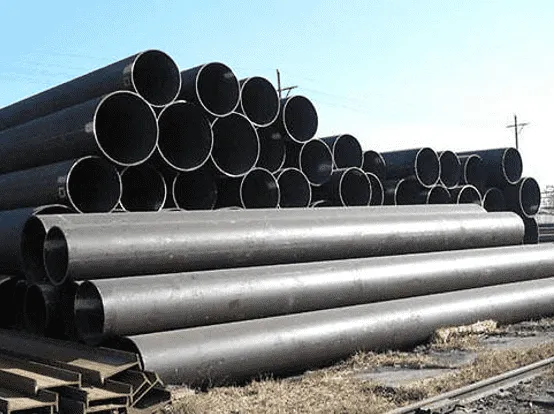
The JCOE method comprises a series of continuous forming stages:
J-shaped: The edges of the sheet metal are pre-bent into a "J" shape using a hydraulic press. C-shape: The central portion is compressed into a "C" shape.
O-shape: The open "C" shape is closed into an "O" shape through gradual compression.
Expansion: Mechanical or hydraulic expansion machines ensure dimensional uniformity.
The following parameters have a significant impact on the quality of LSAW steel pipes:
|
Parameter |
Typical Range |
Impact on Pipe Quality |
|
Press force (J/C stage) |
10,000–50,000 kN |
Excessive force induces microcracks |
|
Bending radius |
1.5–3.0 × pipe diameter |
Smaller radii increase strain hardening |
|
Expansion ratio |
0.8–1.2% |
Over-expansion reduces yield strength |
|
Welding speed |
0.8–1.5 m/min |
Higher speeds may cause lack of fusion |
|
Preheating temperature |
100–200°C |
Reduces residual stress in HIC-prone steels |
Finite element analysis (FEA) shows that JCOE exhibits a more uniform strain distribution compared to UOE, thus mitigating localized thinning. However, the stepped structure of JCOE introduces a slight ellipticity, requiring precise expansion control.
Typically, the JCOE process can produce:
Outer Diameter: 406 mm – 1524 mm (16" – 60")
Wall Thickness: 6 mm – 40 mm
Pipe Steel Grade: API 5L X52 – X80 (some up to X100)
Single Length: 9 – 12.2 m
API 5L X70 LSAW steel pipes manufactured using JCOE, UOE, and three-roll bending processes were compared.
|
Property |
JCOE |
UOE |
Three-Roll Bending |
|
Yield strength (MPa) |
485–520 |
470–500 |
460–490 |
|
Tensile strength (MPa) |
570–610 |
560–590 |
550–580 |
|
Elongation (%) |
28–32 |
26–30 |
25–28 |
|
Impact energy (J, -20°C) |
80–100 |
70–90 |
60–80 |
JCOE exhibits superior strength and toughness due to controlled work hardening and reduced heat-affected zone (HAZ) degradation.
UOE pipes have better roundness (deviation ≤0.5%), while JCOE LSAW steel pipes have an ellipticity of 0.8%–1.2% before expansion. However, after expansion, the roundness of JCOE LSAW steel pipes is comparable to that of UOE pipes (≤0.6%). X-ray diffraction residual stress measurements show:
JCOE: 200–250 MPa (compressive stress at weld)
UOE: 300–350 MPa (tensile stress in flange area)
Three-roll bending: 400+ MPa (non-uniform distribution)
The lower residual stress in JCOE pipes improves fatigue resistance, which is crucial for deep-water pipelines.
Compared to UOE (ASTM 8-10), JCOE's progressive deformation refines the ferrite-pearlite grain size (ASTM 10-12).
The submerged arc welding (SAW) process for JCOE pipes indicates:
Porosity: <1% (in contrast, UOE porosity is 1.5%–2% due to higher heat input)
HAZ Width: 1.2–1.5 mm (2.0–2.5 mm in UOE)
Hardness: 220–240 HV (consistent hardness at the weld)
LSAW pipes dominate in:
High-pressure natural gas transportation;
Deep-water oil pipelines (wall thickness >25 mm);
Arctic-class pipelines (excellent low-temperature toughness).
Thermomechanical cycling in JCOE alters the microstructure:
X70/X80 steel: Controlled deformation inhibits ferrite grain growth, promoting the formation of acicular ferrite (70-80% volume fraction) and dispersed M/A islands, thereby improving toughness.
X100/X120 steel: The combination of Nb/Ti microalloying and the strain rate (0.1–1 s⁻¹) of JCOE accelerates NbC precipitation, increasing the yield strength by 40–60 MPa.
Weld zone: 240–260 HV (SAW welding wire ER70S-6)
Heat-affected zone: 220–240 HV (tempered bainite)
Base metal: 190–210 HV (fine polygonal ferrite)
Compared to UOE, JCOE's lower residual stress reduces susceptibility to hydrogen-induced cracking. NACE TM0284 testing shows: JCOE pipes: Crack length ratio (CLR) <5%, Crack thickness ratio (CTR) <2%; UOE pipes: CLR 8–12%, CTR 3–5%, due to higher tensile residual stress.
The JCOE forming process is one of the core technologies in modern LSAW steel pipe manufacturing. Its main advantages include: progressive forming reduces residual stress, suitability for thick-walled and high-strength pipeline steels, excellent weld quality and toughness, and excellent fatigue and HIC resistance.
Address:1177 Huanhu Road, Yuelu District, Changsha, Hunan, China
 WhatsApp
 WeChat