
 简体中文版
简体中文版

As a common and critical connector in piping systems, the surface treatment of pipe tees directly affects their corrosion resistance, service life, appearance quality, and application safety. In fields such as petroleum, chemical, power, water supply and drainage, and marine engineering, different working conditions place different requirements on the surface treatment of pipe tees.
Selecting the right surface treatment
process can not only reduce later maintenance costs but also significantly
improve the overall reliability of the piping system. Common surface treatment
technologies for pipe tees include: electroplating, coating,
passivation, blackening, phosphating, and sandblasting.
Electroplating is a widely used surface
treatment method. It involves depositing a metal coating, such as chromium
plating or zinc plating, on the surface of the pipe tee.
Chromium plating improves the surface
hardness, wear resistance, and corrosion resistance of the pipe tee, giving it
a brighter appearance; zinc plating mainly serves as a rust preventative
measure and is relatively inexpensive.
Applicable Materials: Carbon steel,
low-alloy steel.
Typical Applications: Machinery, building
piping, light industrial systems.
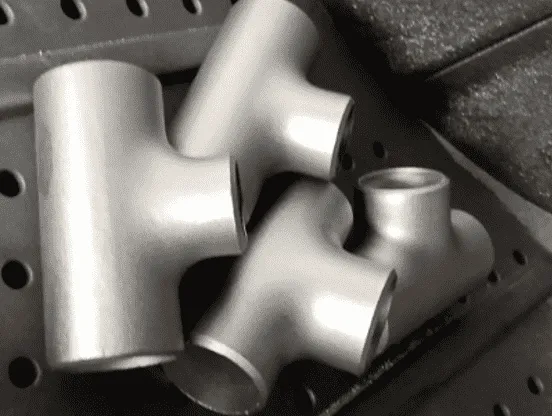
Coating is also a common technique. Various
coatings can be applied, such as anti-corrosion paint and epoxy paint.
The coating forms a protective film on the
surface of the pipe tee, isolating it from air, moisture, and chemicals,
preventing rust and corrosion.
Different coatings are suitable for
different environments; for example, epoxy zinc-rich paint is often used in
harsh corrosive environments such as marine environments.
Passivation treatment is used for some
metal pipe tees. Through specific chemical treatments, a dense oxide film is
formed on the metal surface, enhancing its corrosion resistance.
For example, passivation treatment of
stainless steel pipe tees improves its corrosion resistance and maintains the
surface finish.
Common standards: ASTM A380 / ASTM A967
Blackening treatment is commonly used for
steel pipe tees. Through a chemical reaction, a black oxide film is generated
on its surface, which not only provides some rust prevention but also gives the
pipe tee a unique appearance.
Applicable scenarios: Mechanical equipment,
indoor pipelines, non-highly corrosive environments.
Phosphating treatment forms a phosphate
film on the surface of the pipe tee, improving its corrosion resistance and
coating adhesion.
Before coating, phosphating treatment
enhances the adhesion between the paint and the pipe tee surface, ensuring
coating quality.
Sandblasting treatment uses a high-speed
stream of sand to impact the surface of the pipe tee, giving it a certain
roughness. This helps with the adhesion of subsequent coatings, while also
improving the appearance of the pipe tee and removing surface impurities and
oxide scale.
Common surface grade reference: Sa 2.5 / Sa
3.0 (ISO 8501-1)
Surface treatment of pipe tees is not only
an aesthetic process but also a crucial step in ensuring the safety,
durability, and stable operation of piping systems. By appropriately selecting
treatment methods such as electroplating, coating, passivation, phosphating, or
sandblasting, the corrosion resistance and engineering adaptability of pipe
tees can be effectively improved.

Address:1177 Huanhu Road, Yuelu District, Changsha, Hunan, China
 WhatsApp
 WeChat