
 简体中文版
简体中文版

As a widely
used structural material, the strength of steel plate is one of the core
indicators for evaluating its performance. Strength determines the steel
plate's ability to resist deformation and failure under stress, and is a
multifaceted and rigorously considered factor in engineering design, material
selection, and manufacturing processes. This article will discuss the strength
grades of steel plates, influencing factors, testing methods, and applications
in different fields.
The strength of a steel plate generally
refers to its ability to resist external forces without failure. In
engineering, it is mainly quantified through several key parameters:
This is the stress value at which the
material begins to undergo significant plastic deformation. When the stress on
the steel plate is below the yield strength, the deformation can be fully
recovered after unloading; once the stress exceeds this point, the material
will undergo irreversible deformation. Yield strength is an important basis for
designing allowable stress.
This is the maximum stress value that the
material can withstand in a tensile test, representing the ultimate load the
material can withstand before fracture. It reflects the load-bearing potential
of a material, but is usually not used as a direct design basis because the
component may fail due to excessive plastic deformation before reaching its
tensile strength.
While strictly speaking not a
strength indicator, it is related to the toughness of a material and reflects
its ability to undergo plastic deformation before fracture. High-strength steel
plates often need to increase strength while maintaining a certain elongation
to ensure safety.
The internationally used methods for
classifying the strength grades of steel plates mainly include the following
standards:
The American Society for Testing and
Materials (ASTM) classifies steel into four grades: A, B, C, and D, with grade
A having the highest strength and grade D having the lowest.
The strength grades are, in descending
order: A36, A283C, A572 Gr.50, A573 Gr.70, A588, A242, A709 Gr.36, A709 Gr.50,
A709 Gr.50W, A709 Gr.70W, ASTM A992, ASTM A1011, ASTM A1018, etc.
European standards (EN) classify steel into
four grades: S, P, N, and L, with S grade having the highest strength and L
grade having the lowest. The strength grades are, in descending order: S235JR,
S235J0, S235J2, S275JR, S275J0, S275J2, S355JR, S355J0, S355J2, S355K2, S450J0,
S355J2W+N, S355J2W, etc.
The strength of steel plates is usually
classified according to their yield strength and tensile strength. Common
strength grades include:
The yield strength is generally around 235
MPa, and the tensile strength is approximately 370-500 MPa. These steel plates
have good plasticity and weldability, and are relatively inexpensive, making
them widely used in building structures, general machinery manufacturing, and
other fields.
For example, in some simple building
frames, low-carbon steel plates can meet basic strength requirements and are
easy to process and install.
Yield strength between 345-550 MPa, tensile
strength up to 510-720 MPa. The strength and toughness of the steel plate are
improved by adding small amounts of alloying elements such as manganese and
silicon.
Commonly used in the manufacture of
important structural components for large steel structures, ships, and bridges,
as these structures require high strength and good fatigue resistance.
Yield strength exceeding 550 MPa, tensile
strength reaching 780-1000 MPa or even higher. These steel plates typically
employ special smelting and processing techniques, resulting in extremely high
strength, but are more difficult to process and therefore more expensive.
Primarily used in aerospace, automotive
manufacturing, and other fields with extremely stringent strength requirements
to reduce component weight and improve performance.
In addition, there are ultra-high-strength
steel plates, with yield strengths exceeding 1000 MPa, mainly used in military
and other specialized fields, such as the manufacture of tank armor and missile
casings.
Different strength grades of steel plates
have different performance characteristics. In practical applications, the
appropriate steel plate strength grade must be selected based on specific usage
requirements and working conditions to ensure the safety and reliability of the
structure.
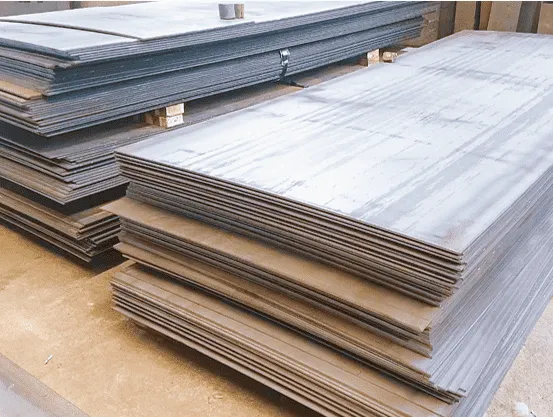
The strength of steel plates is not fixed;
it is influenced by a combination of factors, primarily including:
Steel is based on iron. By adding alloying
elements such as carbon, manganese, silicon, chromium, nickel, and molybdenum,
its microstructure and properties can be significantly altered.
For example, carbon is one of the most
effective elements for increasing steel strength, but excessively high carbon
content can reduce toughness and weldability. The addition of other alloying
elements is usually used to form more complex strengthening mechanisms or
improve specific properties.
The entire production process, from
smelting and continuous casting to rolling, has a decisive impact on the final
strength.
-Hot Rolling: Steel plates are rolled at
high temperatures and then cooled, typically resulting in a product with lower
strength but good toughness and formability.
- Cold Rolling: Further rolling of
hot-rolled steel plates at room temperature significantly improves strength and
hardness through work hardening, but reduces plasticity.
- Heat Treatment: Through processes such as
quenching (rapid cooling) and tempering (medium-temperature heating), the
combination of strength, toughness, and hardness of steel plates can be
significantly adjusted to obtain high-strength materials such as quenched and
tempered steel.
- Controlled Rolling and Cooling: By
precisely controlling the rolling temperature and cooling rate, grains are
refined, thereby simultaneously improving strength and toughness without
excessive reliance on alloying elements.
The strength of steel fundamentally depends
on its internal structure. Common microstructures include ferrite (softer),
pearlite (higher strength), bainite, and martensite (very high strength).
Obtaining fine, uniform grains and microstructure through process control is an
effective way to improve strength.
For steel plates of the same grade,
different thicknesses can result in different strengths. Thicker steel plates
may have different cooling rates between the core and surface during rolling
and cooling, potentially leading to uneven microstructure and affecting overall
strength performance.
To ensure steel plate performance meets
requirements, a variety of standardized testing methods are used for
evaluation.
This is the most basic and core mechanical
property test. The steel plate is processed into a standard specimen, slowly
loaded onto a tensile testing machine until it breaks, and its stress-strain
curve is recorded, thus accurately obtaining data such as yield strength,
tensile strength, and elongation.
Hardness can indirectly reflect the
strength of a material to some extent. Commonly used methods include Brinell
hardness, Rockwell hardness, and Vickers hardness testing. Hardness testing is
relatively simple to operate and causes minimal damage to the workpiece, often
used for on-site quality control and rapid assessment of material condition.
This is mainly used to evaluate the
toughness of steel plates under low temperature or dynamic loads, i.e., the
ability to resist brittle fracture. Although it does not directly measure
strength, high strength and good impact toughness are indispensable for steel
structures used in cold or impact load environments.
Selecting the appropriate strength grade of
steel plate requires comprehensive consideration of usage conditions, safety
requirements, and economic efficiency.
In high-rise buildings and large stadiums,
structural steel with good weldability and sufficient strength is mainly used.
The strength must meet the design load requirements, while diversification
ensures sufficient toughness and seismic performance to cope with dynamic
effects such as wind loads and earthquakes. Economy is also an important
consideration; optimizing steel usage to control costs while ensuring safety is
paramount.
Steel plates used in excavators, crane
booms, etc., need to withstand enormous alternating loads and impacts.
High-strength steel plates with high fatigue strength are often selected to
reduce equipment weight, improve operational performance, and extend service
life. Additional requirements may also be placed on wear resistance.
In automobile manufacturing, steel plates
of different strength grades are widely used in body frames and crash barriers.
High-strength steel or even ultra-high-strength steel is used in areas
requiring high rigidity and safety to achieve lightweighting and reduce energy
consumption while ensuring collision safety. Steel used in ships and bridges
particularly emphasizes a combination of strength, toughness, and corrosion
resistance.
Pressure vessels used for storing or
transporting gases and liquids require steel plates that possess uniform
mechanical properties and excellent toughness to withstand internal pressure,
preventing catastrophic brittle fracture. Extremely high requirements are
placed on material purity and defect control.
In general manufacturing sectors such as
home appliances and furniture, the requirements for steel plate strength are
relatively broad, with greater emphasis on material formability, surface
quality, and cost. Medium-strength, easily stampable cold-rolled or hot-rolled
steel plates are typically used.
When selecting the strength grade of steel
plates, the following factors need to be considered:
Select an appropriate strength grade based
on the operating environment of the steel plate. For example, in harsh
environments such as high temperatures and corrosion, steel plates with higher
strength and corrosion resistance are required.
Select an appropriate strength grade based
on the magnitude of the load the steel plate needs to withstand. For heavier
loads, a higher strength grade steel plate is required.
Consider the machinability of the steel
plate when selecting a suitable strength grade. High-strength steel plates may
be more difficult to process, thus requiring a trade-off between strength and
machinability.
While meeting product performance
requirements, a balance needs to be struck between the strength grade of the
steel plate and its cost. High-strength steel plates are typically more
expensive, so a balance must be found between performance and cost.

Address:1177 Huanhu Road, Yuelu District, Changsha, Hunan, China
 WhatsApp
 WeChat