
 简体中文版
简体中文版

Steel plates are an extremely common metal material in industrial manufacturing, construction engineering, and daily processing. Whether building factory frames, manufacturing machinery, or making sturdy containers, we need to know the exact weight of the steel plates used. This is related to cost accounting, transportation arrangements, and structural safety.
This article will systematically explain
the calculation method for steel plate weight, the principles behind the
formula, key influencing factors, and precautions in practical applications.
The core formula for calculating the weight
of a steel plate is very straightforward:
Weight = Volume × Density
For regularly shaped steel plates, their
volume equals the surface area multiplied by the thickness. The formula can be
further specified as:
Weight = Length × Width × Thickness × Density
To make the formula applicable to different
units of measurement, unit conversion is needed. In engineering practice, the
most commonly used calculation form is as follows:
Weight (kg) = Length (m) × Width (m) × Thickness (mm) × 7.85
Example:
Assume a steel plate that is 2 meters long,
1 meter wide, and 10 millimeters thick.
Calculate its weight: Weight = 2m × 1m × 10mm × 7.85 =
157kg.
This means that a piece of such a steel
plate weighs approximately 157kg.
Length and Width: These usually refer to
the effective planar dimensions of the steel plate. For rectangular or square
steel plates, measure the two vertical sides. Note that some steel plates may
have burrs or irregular edges; measurements should be taken according to the
actual net dimensions used.
Thickness: This is a critical parameter,
and errors significantly affect the results. The thickness of a steel plate is
not uniform throughout. Measurements should be taken at multiple points (such
as the four corners and the midpoint) using calipers, and the average value
should be used for calculation. The nominal thickness of steel plates on the
market (e.g., 10mm) sometimes has a slight tolerance compared to the actual
average thickness; in precise calculations, actual measurements should be used.
The 7.85 in the formula is based on the
typical density value of ordinary carbon steel (e.g., Q235). The density of
steel is not constant; it varies with the alloy composition.
Common steel density references:
Ordinary carbon steel, low-alloy steel:
approximately 7.85 g/cm³ (using a coefficient of 7.85).
Stainless steel: higher density, for
example, 304 stainless steel is approximately 7.93 g/cm³, with a calculation coefficient of approximately 7.93.
High-alloy tool steel, some special steels:
density may vary slightly, fluctuating between 7.7 and 8.0.
When calculating the weight of special
steel plates (such as stainless steel, wear-resistant steel), consult or
confirm the exact density value of that grade of steel and replace 7.85 in the
formula.
Unit confusion is the most common cause of
calculation errors. Always remember the commonly used combination:
SI (International System of Units)
combination: Length (m) × Width (m) × Thickness (m) × Density (7850 kg/m³) = Weight (kg). This is the least error-prone method.
Common engineering formula: Length (m) × Width (m) × Thickness (mm) × 7.85 = Weight (kg). This is the most convenient way to remember it.
If the dimensions are in centimeters (cm),
the formula becomes: Length (cm) × Width (cm) × Thickness (cm) × Density (7.85g/cm³) = Weight (grams), then divide by 1000 to get kg.
It's a good habit to convert all dimensions
to the same unit system (ideally meters or centimeters) before calculating to
avoid errors.
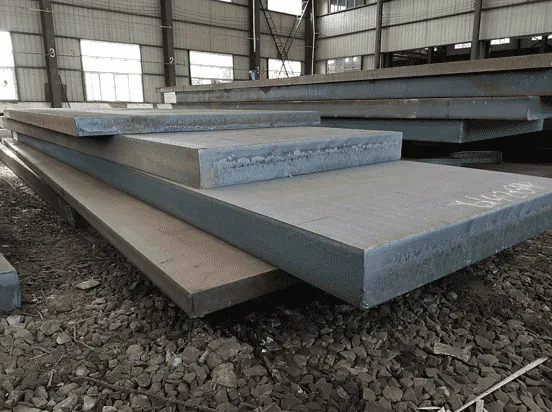
The basic formula applies to standard rectangular
plates. In practice, more diverse situations will be encountered.
For circular steel plates (discs): Weight = π × Radius (m)² × Thickness (m) × Density (7850kg/m³).
Simplified, it is approximately: Diameter (m)² × 0.6165 × Thickness (mm). (Where 0.6165 is an approximation of π/4 × 7.85)
For irregularly shaped but uniformly thick
steel plates, first calculate their planar area (this can be done by drawing
and measuring using CAD software or by breaking them down into multiple regular
shapes), then apply the formula: Weight = Area (square meters) × Thickness (meters) × 7850.
When calculating the total weight of
multiple steel plates of the same specification, simply multiply the weight of
each plate by the quantity. For batches with different specifications,
calculate each plate separately and then sum them.
The weight calculated using the formula is
called the "theoretical weight" or "ideal weight." It is
the result calculated under standard density and ideal geometric dimensions."Actual
weight" is the actual weight of the steel plate obtained by weighing.
There are usually slight differences
between the two, due to reasons including:
Dimensional tolerances: Allowable
deviations in thickness, length, and width during production.
Density fluctuations: Slight fluctuations
in material composition.
Surface Condition: Scale (rust), coatings,
etc., on the surface of steel plates increase their actual weight.
In trade and budgeting, theoretical weight
is usually used as the basis for settlement and estimation because it is
standardized and repeatable. For large transactions, the actual weighed weight
is agreed upon.
Mastering this formula is crucial on
several levels:
Before project procurement, the total
weight of required steel can be accurately estimated, thereby calculating
material costs and preventing budget overruns.
Knowing the weight of the steel plates
allows for the rational arrangement of transport vehicles (avoiding
overloading) and the selection of appropriate lifting and handling equipment
(such as cranes and forklifts) to ensure operational safety.
In mechanical design or building structures, the self-weight of
the steel plates is part of the load. Accurately calculating its weight is the
basis for structural strength and stability analysis.
For warehousing departments, calculations
allow for quick inventory checks of theoretical stock weights, aiding in
material management.
In the processes of steel plate cutting and
welding, understanding the workpiece weight helps in arranging the process
sequence and support scheme.
The formula for calculating the weight of a
steel plate, "weight = length × width × thickness × 7.85", is a practical tool
that combines geometric dimensions with the physical properties of the
material. It seems simple, but it contains a unified principle. To use it
skillfully and accurately, the key lies in three points: first, ensuring the
accuracy of dimensional measurements, especially thickness; second, selecting
the correct density value according to the steel plate material; and third,
maintaining a high degree of consistency in units throughout the calculation
process.

Address:1177 Huanhu Road, Yuelu District, Changsha, Hunan, China
 WhatsApp
 WeChat