
 简体中文版
简体中文版

Electrical
resistance welded (ERW) pipe is a type of welded pipe. They are made
from high-quality steel coils through a forming process. A series of rollers
roll a flat steel coil or ring into a cylindrical shape. Then, electricity is
applied to heat the edges of the pipe, achieving seam welding.
ERW steel pipes commonly use the following
materials:
Low carbon steel (most commonly used): easy
to weld, good plasticity, excellent formability
Stainless steel (for specific media
requirements): strong corrosion resistance but higher cost
Some manufacturers also coat the inside and
outside of the pipe with FBE fusion-bonded epoxy powder coating, significantly
improving its corrosion resistance, suitable for long-term outdoor or buried
environments such as oil and gas, water treatment, and structural engineering.
The manufacturing process of ERW welded
pipes is indeed quite complex. It involves multiple steps to process a flat
steel coil into a pipe shape. Let's delve into the detailed manufacturing
process of these welded pipes and explain it step by step.
First, you need to prepare a sufficiently
long roll of high-quality steel. The length of this steel coil must be
sufficient to produce a steel pipe of adequate length. Note that various types
of steel are available on the market, each with different carbon contents, some
with lower carbon content.
You should choose low-carbon steel because
it has many advantages.
First, this steel is easy to weld without
any problems.
Furthermore, its forming process is safe
and it won't crack under the rollers.
If you choose high-carbon steel, it is not
suitable for welding, requiring a higher current during welding, thus
increasing production costs.
Tip: Steel pipes with a carbon content
higher than 0.6% are more rigid and prone to cracking during welding, resulting
in poor weld quality and easy breakage.
This is one of the most critical steps in
the ERW welded pipe manufacturing process. First, the flat steel coil undergoes
an edge trimming process. These steel strips are irregular in shape and size,
and the edge trimming process removes these irregularities. If these edges are
not cut and ground, the weld strength will be very low.
Therefore, you should carefully inspect the
strip edges. If any minor irregularities are found, be sure to repair them.
This pipe uses a solid welding process. However, due to the irregularities at
the edges of the strips, the weld quality may be affected, thus impacting the
overall quality of the pipe.
The formed circular pipe blank enters a
high-frequency welding machine (HFW welder).
High-frequency welding process:
High-frequency current generates resistance
heat at the edges of the pipe blank;
The edges are heated to a molten state;
Pressure is applied by squeeze rollers to
form a metallurgical bond;
No welding wire or filler metal is required
during the welding process;
The outer and inner weld ribs are
selectively removed after welding (outer or inner rib removal) depending on the
application.
The advantages of high-frequency welding
are high welding speed, small heat-affected zone, continuous and dense weld
metal, and weld strength equivalent to the base material.
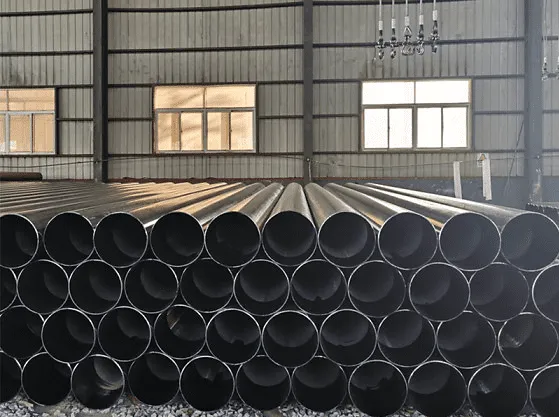
These ERW welded pipes are extremely
durable and robust. Heat treatment is the primary reason for their durability.
The welded pipe is heated to a high temperature and then cooled in air,
resulting in a significant temperature change.
The effects of heat treatment:
Eliminate welding stress;
Improve grain structure, resulting in a
more uniform weld;
Enable weld strength to reach or exceed
that of the base material;
Improve pressure resistance.
Therefore, ERW steel pipes can be safely
used for pressurized transportation, such as urban water supply, fire
protection systems, and oil and gas gathering and transportation.
After heat treatment, the pipes are ready
for use. Manufacturers use sizing mills for cutting. These mills are highly
efficient, ensuring precise pipe diameter and roundness.
You can cut ERW welded pipes into any
number of sections as needed. There are no size restrictions for these pipes.
A quality control system is crucial to
every production process. It acts as an additional quality check, ensuring
customers do not receive substandard pipes.
Eddy Current Testing (ECT): Detects weld
defects.
Ultrasonic Testing (UT): Inspects for
internal cracks.
Hydrostatic Testing: Tests pressure
resistance.
Dimensional Inspection: Outer diameter, wall thickness, roundness.
Surface Inspection: Locates scratches,
cracks, and shrinkage cavities. Mechanical property testing: tensile, bending,
and impact testing.
Unlike ERW steel pipes, these seamless
steel pipes have no weld seams. They are formed by extruding a single piece of
steel billet, not by welding.
Seamless steel pipes are strong and durable
because they have no weld seams, making them less prone to rust. However, they
are also more expensive.
These spiral pipes are not as good as
seamless pipes. The steel plates are welded in a spiral pattern, and the weld
seams are clearly visible. This type of pipe is made using this welding
process.
However, the weld seams on these pipes
reduce their strength. They are cheaper than seamless steel pipes but more
expensive than ERW steel pipes.

Address:1177 Huanhu Road, Yuelu District, Changsha, Hunan, China
 WhatsApp
 WeChat