
 简体中文版
简体中文版

A 90-degree elbow is a pipe fitting used to change the direction of a pipe by 90 degrees. The most common types are long radius (LR) pipe elbows and short radius (SR) pipe elbows, typically made of materials such as steel, brass, chromium alloy, stainless steel, or plastic. It is widely used in residential and commercial applications. Its structure varies depending on the material, size, and pressure rating.
1. 90-degree elbows can be made of a variety of materials, such as brass, copper, PVC, stainless steel, or iron.
2. Depending on the requirements of the piping system, the inner diameters at both ends can be equal or unequal.
3. The ends of a 90-degree elbow can be connected to the pipe by threading, welding, or brazing. For flexible connection options, the ends can be internally or externally threaded.
4. 90-degree elbows are available in a wide range of sizes, from the smallest 1/8-inch pipe elbow to the largest 48-inch pipe elbow.
90-degree elbows are manufactured using a variety of materials to meet different applications, media, and pressure/temperature requirements. Common materials include:
Stainless steel (e.g., 304, 304L, 316, 316L);
Carbon steel (e.g., A234 WPB);
Alloy steel;
Copper;
Polyvinyl chloride (PVC);
Chronicized polyvinyl chloride (CPVC);
Brass;
Cast iron.
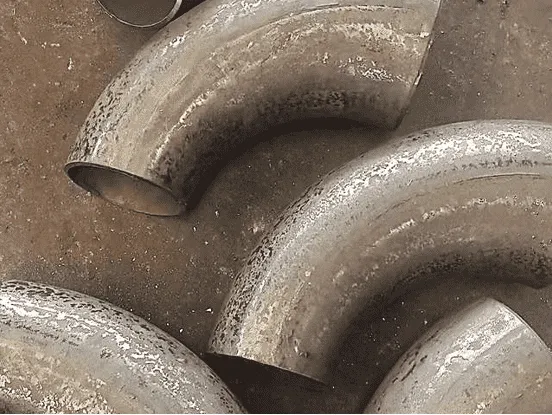
90-degree elbows are mainly divided into two types: long radius pipe elbows (LR) and short radius pipe elbows (SR).
The bending radius (R) is 1.5 times the nominal pipe diameter (NPS) or outer diameter (D) (R = 1.5D). This allows for a smoother turn, reducing friction, turbulence, and pressure drop. This design is usually preferred when space permits and flow efficiency is critical.
The bending radius (R) is equal to the nominal pipe diameter (NPS) or outer diameter (D) (R = 1.0D). This results in a sharper bend, increasing turbulence and pressure drop, but with a more compact structure, suitable for confined spaces requiring a smaller bending radius.
|
ASME B16.9 - 90 Degree Elbow Dimensions |
||||||
|
Nom Size |
OD 'A' |
Radius 'B' |
Sch STD |
Sch XS |
Sch 160 |
Sch XXS |
|
1/2 |
21.3 |
38 |
0.09 |
0.09 |
|
|
|
3/4 |
26.7 |
29 |
0.14 |
.09 |
|
|
|
1 |
33.4 |
38 |
0.18 |
0.23 |
0.27 |
0.36 |
|
1 1/4 |
42.2 |
48 |
0.23 |
0.32 |
0.45 |
0.63 |
|
1 1/2 |
48.3 |
57 |
0.34 |
0.45 |
0.81 |
0.90 |
|
2 |
60.3 |
76 |
0.68 |
0.9 |
1.44 |
1.71 |
|
2 1/2 |
73 |
95 |
1.35 |
1.8 |
2.70 |
3.20 |
|
3 |
88.9 |
114 |
2.03 |
2.7 |
4.05 |
5.04 |
|
3 1/2 |
101.6 |
133 |
2.8 |
3.83 |
|
7.3 |
|
4 |
114.3 |
152 |
3.8 |
5.4 |
8.5 |
9.5 |
|
5 |
141.3 |
190 |
6.4 |
9.0 |
15 |
17 |
|
6 |
168.3 |
229 |
10.4 |
14 |
27 |
28 |
|
8 |
219.1 |
305 |
20 |
31 |
57 |
54 |
|
10 |
273 |
381 |
35 |
50 |
122 |
|
|
12 |
323.8 |
457 |
53 |
68 |
207 |
|
|
14 |
355.6 |
533 |
66 |
86 |
253 |
|
|
16 |
406.4 |
610 |
91 |
116 |
371 |
|
|
18 |
457.2 |
686 |
115 |
147 |
|
|
|
20 |
508 |
762 |
139 |
189 |
|
|
|
24 |
610 |
914 |
177 |
234 |
|
|
|
26 |
660.4 |
991 |
201 |
273 |
|
|
|
30 |
762 |
1143 |
331 |
429 |
|
|
|
36 |
914 |
1372 |
478 |
635 |
|
|
|
42 |
1067 |
1600 |
616 |
820 |
|
|
Installing a 90-degree elbow is a simple process requiring only some basic plumbing tools.
1. Ensure the pipe end is clean and free of rust, debris, or burrs.
2. Depending on the connection method, the pipe elbow may need to be connected to the pipe via threaded connection, welding, or brazing.
3. Always align the centerline of the pipe elbow with the centerline of the pipe to avoid any blockages or kinks in the system.
4. Test the pipe elbow joint for leaks before operating the system.
90-degree pipe elbows are a fundamental component in many industries:
Residential and commercial water supply and sewage piping.
Air handling and ventilation ducts.
Refineries, pipelines, offshore platforms.
Used for processing and transporting various chemicals.
Used for steam pipelines and cooling water systems.
Used for hygienic and corrosion-resistant piping.
Any system requiring a 90-degree change in fluid direction.
In summary, the 90-degree elbow is an important piping fitting widely used in various applications. It is available in a variety of materials, inner diameters, and types, each suitable for different system requirements. Choosing the right pipe elbow can improve system efficiency, reduce friction loss, and extend the service life of the piping system. It is essential to follow the correct installation and testing procedures to prevent leaks and ensure proper operation.

Address:1177 Huanhu Road, Yuelu District, Changsha, Hunan, China
 WhatsApp
 WeChat