
 简体中文版
简体中文版

Pipe fittings are an indispensable component of water supply, drainage, industrial piping, and HVAC systems, facilitating the smooth flow of liquids and gases. Among various types of pipe fittings, pipe elbows are crucial for changing the direction of fluid flow. The two most common types of pipe elbows are 45-degree elbows and 90-degree elbows.
Understanding the differences between these
two types of pipe elbows is essential for selecting the right pipe elbow for
your specific application. This article will explore the characteristics,
applications, advantages, and differences between 45-degree and 90-degree
elbows.
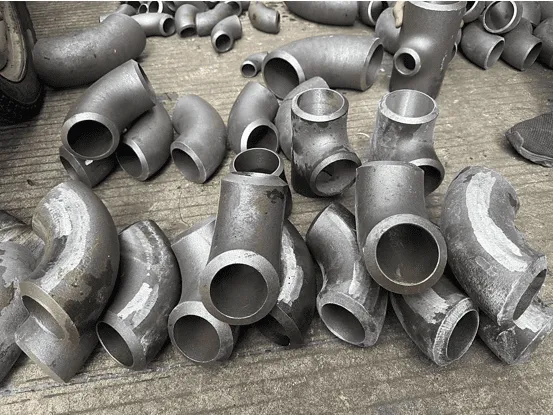
Pipe elbows are pipe fittings used to
change the direction of a piping system. They are typically used to connect two
pipes and change the flow direction of fluids or gases. Pipe elbows come in
different angles, with 45-degree and 90-degree being the most common.
These pipe elbows are made from a variety
of materials, including stainless steel, carbon steel, alloy steel, PVC, etc.,
to meet different needs and environments.
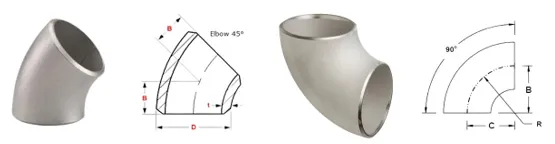
45-degree pipe elbows are designed to
connect two pipes at a 45-degree angle, allowing for a smoother change in
direction.
Smooth Flow: The gentle curve provides
smoother flow, minimizing turbulence.
Reduced Pressure Loss: Helps maintain
pressure levels within the system.
Minimum Space Requirement: Requires less
space for installation compared to sharper angles.
HVAC Systems: Ideal for air handling and
ventilation, ensuring efficient airflow.
Pipes: Used in water supply lines for a
smooth transition.
Chemical Treatments: Suitable for systems
requiring gentle changes in direction.
In systems where maintaining flow
efficiency is critical, 45-degree elbows are often the preferred choice, as
their gentle curve helps reduce wear on the piping system.
A 90-degree elbow is used to connect two
pipes at a right angle, allowing for a more abrupt change in direction.
Right-Angle Connection: Provides a sharp
turn, changing the direction of water flow at a right angle.
Increased pressure drop: This can lead to
greater turbulence and pressure loss.
Space saving: Allows for compact
installations in space-constrained environments.
Pipes and drainage: Commonly used to change
flow direction in wastewater systems.
Industrial piping: Suitable for fluid
diversion in compact systems.
Oil and gas: Used in space-constrained
high-pressure systems.
In space-constrained environments,
90-degree elbows are often chosen, and the system can withstand greater
pressure drop and turbulence.
While both pipe elbows and right-angle
elbows are used to change the flow direction of fluids in piping systems, there
are several key differences:
45-degree elbow: Connects two pipes at a
45-degree angle, providing a smoother change of direction.
90-degree elbow: Connects two pipes at a
right angle (90 degrees), providing a more abrupt change of direction.
45-degree elbow: Provides smoother fluid
flow, reducing turbulence and pressure drop. It is often used in systems with
high flow efficiency requirements.
90-degree elbow: Causes greater turbulence
and pressure loss, which may be acceptable in systems with sufficient pressure
handling capacity.
45-degree elbow: Requires more space for
installation due to the smaller bend angle.
90-degree elbow: Saves space and is
suitable for compact installations with limited space.
45-degree elbow: Suitable for HVAC,
chemical processing, and systems requiring a smooth flow transition.
90-degree elbow: Commonly used in
space-constrained piping, drainage, and industrial piping.
These two types of pipe elbows each have
their unique advantages to meet specific needs and applications:
Smooth flow: Ensures minimal turbulence and
maintains flow efficiency.
Reduced wear: The gentle curve reduces
pressure on the piping system.
Versatile Applications: Suitable for a wide
range of applications, including HVAC and chemical processing.
Compact Design: Ideal for space-constrained
installation environments.
Affordable: Typically less expensive due to
its simple design.
Wide Applications: Commonly used in
residential and industrial piping systems.
Choosing the right pipe elbow for your
piping system requires understanding your specific application requirements,
including:
Consider the effects of turbulence and
pressure drop.
Assess the available space for
installation.
Select the appropriate material based on
your environment and fluid type.
Ensure compliance with industry regulations
and standards.
The differences between 45-degree and
90-degree elbows lie in their bending angle, fluid characteristics, space
requirements, and application areas. Each type of pipe elbow has its own
advantages, meeting different needs and environments.

Address:1177 Huanhu Road, Yuelu District, Changsha, Hunan, China
 WhatsApp
 WeChat