
 简体中文版
简体中文版

API 5CT is a specification for casing and tubing used in oil wells in the oil and gas industry. This standard specifies the technical delivery conditions for steel pipes (casing, tubing, and pup joint), fitting stock, fitting materials, and accessory materials, and establishes requirements for three product specification levels (PSL-1, PSL-2, and PSL-3).
API P110 casing is a type of API 5CT oil well casing primarily used in deep well operations. It can be fitted with various end connections, such as non-thickened or externally thickened ends.
Outer Diameter: 4 1/2″ – 13 3/8″ (114.30 – 339.72 mm)
Wall Thickness: 6.35 – 16.13 mm (varies by specification)
Length: R1 (4.88-7.62m), R2 (7.62-10.36m), R3 (10.36-14.63m)
Thread Type: BTC / LTC / STC
Yield strength up to 110 ksi, capable of withstanding the enormous external extrusion pressure in deep wells and the high pressure during production and fracturing processes.
After quenching and tempering, its strength and toughness are superior to normalized steel grades (such as N80).
Among ultra-high strength steel grades (compared to Q125 and V150), P110 offers superior cost-effectiveness, making it an ideal choice for deep well designs.
It supports cold drawing, hot rolling, and heat treatment processes, meeting diverse engineering requirements.
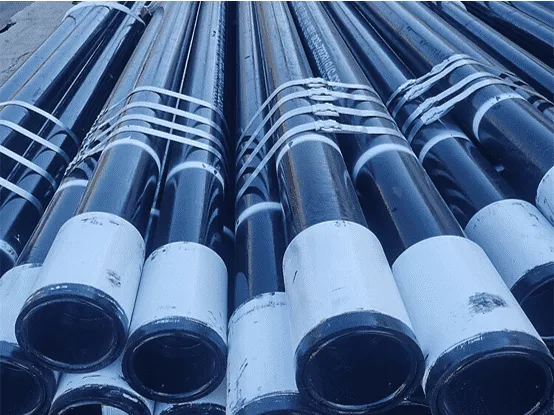
|
Name |
Casing |
Coupling |
|
P110 |
A bright white band |
Entire white coupling |
|
Grade |
C≤ |
Si≤ |
Mn≤ |
P≤ |
S≤ |
Cr≤ |
Ni≤ |
Cu≤ |
Mo≤ |
V≤ |
|
API 5CT P110 |
0.26-035 |
0.17-0.37 |
0.40-0.70 |
0.020 |
0.010 |
0.80-1.10 |
0.20 |
0.20 |
0.15-0.25 |
0.08 |
|
Grade |
Type |
Yield strength MPa |
Tensile strength min. MPa |
Total elongation under load % |
|
P110 |
/ |
758-965 |
862 |
0.6 |
|
Item |
Allowable tolerance |
|
|
Outer diameter |
Pipe body |
D≤101.60mm±0.79mm |
|
D≥114.30mm+1.0% |
||
|
-0.5% |
||
|
Wall thickness |
-12.5% |
|
|
Wight |
Single piece |
+6.5%+3.5% |
|
Total weight |
-1.75 |
|
|
Outer Diameter |
Wall Thickness |
Weight |
Grade |
Threaded |
Length |
|
|
in |
mm |
kg/m |
lb/ft |
|||
|
4 1/2″ |
114.3 |
14.14-22.47 |
9.50-11.50 |
P110 |
LTC/STC/BTC |
R1/R2/R3 |
|
5″ |
127 |
17.11-35.86 |
11.50-24.10 |
P110 |
LTC/STC/BTC |
R1/R2/R3 |
|
5 1/2″ |
139.7 |
20.83-34.23 |
14.00-23.00 |
P110 |
LTC/STC/BTC |
R1/R2/R3 |
|
6 5/8″ |
168.28 |
29.76-35.72 |
20.00-24.00 |
P110 |
LTC/STC/BTC |
R1/R2/R3 |
|
7″ |
177.8 |
25.30-56.55 |
17.00-38.00 |
P110 |
LTC/STC/BTC |
R1/R2/R3 |
|
7 5/8″ |
193.68 |
35.72-63.69 |
24.00-42.80 |
P110 |
LTC/STC/BTC |
R1/R2/R3 |
|
8 5/8″ |
219.08 |
35.72-72.92 |
24.00-49.00 |
P110 |
LTC/STC/BTC |
R1/R2/R3 |
|
9 5/8″ |
244.48 |
48.07-86.91 |
32.30-58.40 |
P110 |
LTC/STC/BTC |
R1/R2/R3 |
|
10 3/4″ |
273.05 |
48.73-97.77 |
32.75-65.70 |
P110 |
LTC/STC/BTC |
R1/R2/R3 |
|
11 3/4″ |
298.45 |
62.50-89.29 |
42.00-60.00 |
P110 |
LTC/STC/BTC |
R1/R2/R3 |
|
13 3/8″ |
339.72 |
71.43-107.15 |
48.00-72.00 |
P110 |
LTC/STC/BTC |
R1/R2/R3 |
P110 has a yield strength approximately 37.5% higher than N80;
At the same strength, P110 has a thinner wall, is lighter, and has a larger inner diameter;
P110 is more economical and efficient in deep well designs.
Both have similar heat treatment processes, but L80's chemical composition and hardness control give it sulfur resistance.
In sulfur-containing environments, even if pressure requirements necessitate the strength of P110, high-strength sulfur-resistant steel grades, such as C95 or T95, must be selected; P110 should never be used.
API 5CT P110 casing is a high-strength, quenched and tempered (Q&T) heat-treated steel grade, primarily used in:
Deep wells;
Ultra-deep wells;
High internal pressure, high external extrusion well conditions;
High-load environments during fracturing and completion stages.

Address:1177 Huanhu Road, Yuelu District, Changsha, Hunan, China
 WhatsApp
 WeChat