
 简体中文版
简体中文版

In modern industrial piping systems, pipe flanges play a crucial role as indispensable connecting components. Whether in petrochemical, power, water supply and drainage, or food and pharmaceutical industries, flanges are ubiquitous wherever pipeline transportation is involved. This article will detail the structure, types, sealing methods, and marking methods of flanges, providing authoritative reference for engineering design and procurement.
A flange is typically disc-shaped with bolt
holes on its outer circumference and a central opening for the pipe or
equipment to pass through.
During installation, two flanges are placed
opposite each other, a gasket is placed between them, and bolts are passed
through the bolt holes and tightened, thus tightly connecting the pipe or
equipment and ensuring that the medium inside the pipeline does not leak. It
also provides a certain degree of support and positioning for the piping
system.
The choice of different materials depends
on factors such as the characteristics of the medium inside the pipeline, the
working pressure, and the temperature.
For example, stainless steel flanges are
often used in chemical pipelines transporting highly corrosive media; while
carbon steel flanges are sufficient for ordinary water pipeline systems.
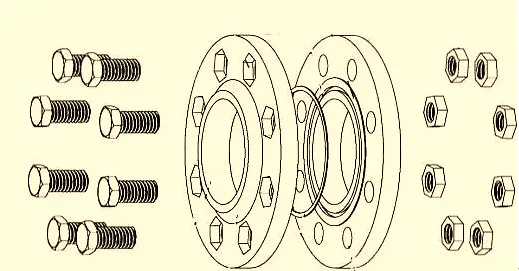
Common pipe flanges include slip-on
flanges, weld neck flanges, socket flanges, loose flanges, and threaded
flanges.
Slip-on flanges are divided into plate
slip-on flanges and neck slip-on flanges. They have a simple structure and low
cost, and are suitable for pipe connections with relatively low pressure and
small diameter.
They are widely used in general civil
building water supply and drainage and low-pressure industrial pipelines.
Socket flanges are suitable for
small-diameter pipes. The pipe is inserted into the socket of the flange and
welded, resulting in a strong connection and good sealing performance.
Weld neck flanges are connected to the pipe
by butt welding. The weld quality is high, and they can withstand higher
pressure and temperature.
They are commonly used in high-temperature
and high-pressure pipeline systems in industries such as petrochemicals and
power.
Loose flanges are characterized by not
being directly welded to the pipe, but rather connected via flanges, steel
rings, or other connecting parts.
They are suitable for non-ferrous metal
pipelines or applications requiring frequent disassembly, reducing damage to
the pipe base material.
Threaded flanges connect to pipes using
threads, making installation and disassembly convenient.
They are generally used in piping systems
with low pressure, small pipe diameter, and frequent maintenance requirements.
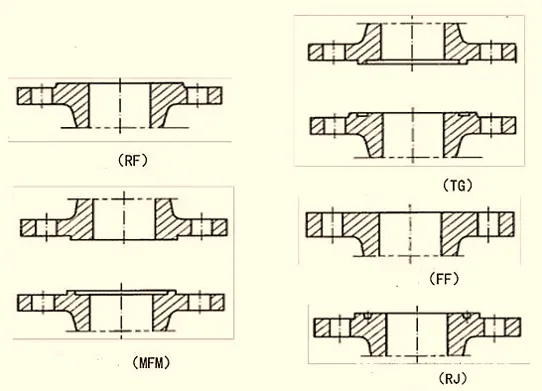
Flange sealing surfaces are classified as
flat face (FF), raised face (RF), male and female face (MFM), tongue and groove
(TG), and ring joint (RJ).
The sealing surface is a smooth plane,
suitable for low pressure and non-toxic media, generally used for water
pipelines and other connections with low requirements.
Also known as a flat face flange, the
sealing surface is flat, resulting in a large contact area with the gasket.
After pre-tightening, the gasket can easily extend or move to the sides,
resulting in poor sealing performance. It is only suitable for low-pressure
applications.
Consists of a concave face and a convex
face. They must be used in conjunction with a convex face during installation.
This type of flange offers better sealing
performance than a flat face flange and is commonly used for medium-pressure
pipeline connections carrying toxic or hazardous media.
The sealing surface consists of a tongue
and a groove, providing excellent sealing performance.
It is generally used for connections of
flammable, explosive, toxic media, and high-pressure pipelines.
A ring joint seal flange has an annular
trapezoidal groove cut into the flange's raised face as the sealing surface.
Like
the tongue and groove seal, the flange must be axially separated during
installation and disassembly. The possibility of axial separation of the flange
must be considered in pipeline design.
This sealing surface is specifically
designed to mate with solid metal gaskets machined into octagonal or elliptical
shapes to achieve a sealed connection. It offers good sealing performance,
requires strict installation, and is suitable for high-temperature and
high-pressure conditions, but demands high precision in sealing machining.
The outer ring or near the sealing surface
of the flange usually displays the following key information:
This indicates the diameter of the pipe to
which the flange will connect, usually in millimeters (mm). For example,
"DN100" indicates that the flange is suitable for pipes with a
nominal diameter of 100 mm.
This indicates the design pressure the flange can withstand, commonly measured in megapascals (MPa) or pounds per square inch (psi). For example, "PN16" indicates a nominal pressure of 16 bar.
American Standard flanges use the CLASS
designation, such as "CLASS 150," indicating a pressure rating of 150
pounds.
The flange material determines its
strength, corrosion resistance, and applicable environment. Common material
designations include:
Carbon steel: such as "A105,"
indicating forged carbon steel.
Stainless steel: such as "304" or
"316," representing different types of stainless steel.
Alloy steel: such as "F22,"
indicating low-alloy steel.
Flanges must be designed and manufactured
to conform to specific standards, such as:
ANSI/ASME B16.5: American Standard flange.
EN 1092-1: European Standard flange.
GB/T 9119: Chinese National Standard
flange.
Some flanges will indicate the heat
treatment process, such as "N" (normalizing) or "QT"
(quenching and tempering).
Selecting the appropriate flange type and
sealing method is a crucial step in ensuring safety, durability, and economy in
piping system design.
Low-pressure, non-hazardous media → Slip-on or threaded flanges, flat or raised face seals;
High-pressure, high-temperature, or
hazardous media → Butt-welded, tongue and groove, or
ring face flanges, stainless steel or alloy steel.
Scientific and reasonable flange selection
can significantly reduce pipeline leakage risks and maintenance costs, and
improve project reliability.

Address:1177 Huanhu Road, Yuelu District, Changsha, Hunan, China
 WhatsApp
 WeChat