
 简体中文版
简体中文版

The temperature requirement for seamless steel pipes is not a fixed value, but a range. This range usually depends on the specific material and application environment. Generally, seamless steel pipes can withstand temperatures ranging from -20℃ to 800℃. For example, seamless steel pipes made of certain special alloy steels have even better high-temperature resistance and can withstand even higher temperatures.
The temperature resistance of seamless
steel pipes is mainly determined by the material. Common types and their
temperature limits are as follows (data referenced from ASTM and GB/T
standards):
Operating temperature: -20℃ to 450℃ (e.g., 20# steel).
Low temperature limit: -40℃ (requires special treatment to avoid cold brittleness).
High temperature limit: Above 450℃, carbon steel will soften significantly, and the tensile strength
will decrease by more than 30% (Source: ASTM A106).
Temperature range: -50℃ to 600℃ (e.g., 15CrMo).
High-temperature advantage: Molybdenum
enhances creep resistance, suitable for boiler piping (GB5310 standard).
Conventional temperature resistance: -200℃ to 800℃ (short-term up to 1200℃).
Oxidation risk: Above 900℃, the chromium oxide layer may peel off (refer to ASTM A312).
Mechanical property degradation: The yield
strength of carbon steel decreases by approximately 50% at 500℃.
Oxidation and creep: Creep rupture life
must be considered for alloy steel pipes above 600℃ (e.g., 12Cr1MoVG steel has a design life of 100,000 hours).
Toughness Requirements: Below -50℃, austenitic stainless steel (such as 304L) or nickel-based alloys
should be used to avoid low-temperature brittleness.
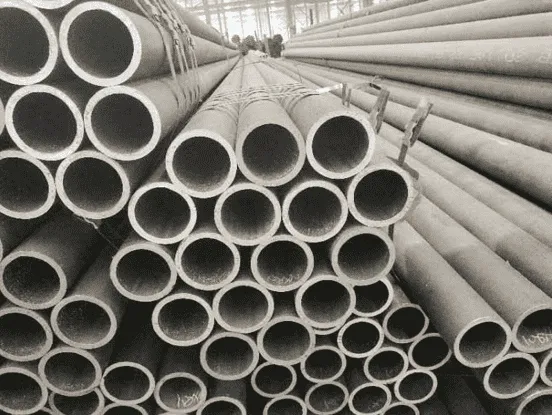
Seamless steel pipes are made of different
metallic materials, each with varying high-temperature resistance. Ordinary
carbon steel seamless pipes are the most common, with a maximum operating
temperature generally around 450℃.
Alloy steel seamless pipes, due to the
addition of alloying elements such as chromium and nickel, have significantly
improved high-temperature resistance, reaching a maximum operating temperature
of 650℃. In addition, there are high-temperature alloy
steel seamless pipes, which can withstand extremely high temperatures,
exceeding 1000℃.
Besides material, the manufacturing process
is also a crucial factor affecting the temperature resistance of seamless steel
pipes. High-quality manufacturing processes ensure a more uniform and dense
internal structure and organization of the steel pipe, thereby improving its
high-temperature resistance.
Conversely, poor manufacturing processes
may lead to internal defects in the steel pipe, reducing its temperature
resistance.
The operating environment is also a crucial
factor determining the operating temperature of seamless steel pipes. For
example, in high-temperature, high-pressure, and highly corrosive environments
such as oil fields and chemical plants, seamless steel pipes with better
high-temperature and corrosion resistance are required.
In contrast, in low-temperature
environments, such as cold storage facilities and liquefied natural gas storage
tanks, seamless steel pipes with good low-temperature toughness are necessary.
High-Temperature Pipelines: Cracking Furnace Tubes (Material 310S, Temperature Resistance 1100℃).
Low-Temperature Storage and Transportation:
LNG Pipelines (Material 9% Nickel Steel, Temperature Resistance -196℃).
Boiler Pipes: P91 Steel (Temperature
Resistance 650℃, ASTM A335 Standard).
Hydraulic Systems: Titanium Alloy Tubes
(Temperature Resistance Range -250℃ to 550℃).
High-temperature tensile test (GB/T 4338).
Low-temperature impact test (ASTM E23).
Select material based on the design temperature + 50℃ safety margin.
For corrosive environments, additional
corrosion resistance requirements are necessary (e.g., 316L is suitable for
chlorine-containing media).
Different materials of seamless steel pipes
have different high-temperature resistance capabilities; the appropriate
material should be selected according to specific requirements.
Adopting advanced production processes can
improve the high-temperature resistance of seamless steel pipes, such as heat
treatment.
When using seamless steel pipes, their
usage conditions must be controlled to avoid exceeding their high-temperature
resistance range.
The temperature resistance of seamless
steel pipes needs to be comprehensively evaluated based on material, process,
and usage conditions. Users should accurately match standard data with actual
working conditions to avoid the risk of failure due to overheating.

Address:1177 Huanhu Road, Yuelu District, Changsha, Hunan, China
 WhatsApp
 WeChat