
 简体中文版
简体中文版

There are three main manufacturing processes for pipe tees: hydraulic bulging, hot pressing, welding, and machining.
Hydraulic expansion forming utilizes liquid
as the force transmission medium. The pipe blank is placed into a mold cavity,
and high-pressure liquid is applied inside the blank, causing plastic
deformation under the liquid pressure, thus conforming to the mold cavity and
forming the shape of a tee.
This process mainly relies on the plastic
deformation capacity of the pipe blank material. The tee is formed by
controlling the liquid pressure and deformation time.
Select appropriate pipe blank material and
dimensions according to the tee's specifications and design requirements. Pipe
blank materials are typically carbon steel, stainless steel, alloy steel, etc.,
and their chemical composition and mechanical properties should meet relevant
standards.
Cut the pipe blank, ensuring that the
length and end face quality meet the requirements. Cutting methods can include
sawing, laser cutting, etc., to ensure a smooth, burr-free cut.
Design and manufacture the corresponding
mold according to the shape and dimensions of the tee. A mold typically
consists of an upper mold, a lower mold, and a core mold, and its cavity shape
should match the outline of the tee.
The mold material should possess sufficient
strength, hardness, and wear resistance to ensure it does not deform or wear
during repeated use. Commonly used mold materials include alloy tool steel and
cemented carbide.
The pipe blank is cleaned to remove surface oil, rust, and other impurities to ensure a good fit between the pipe blank and the mold.
A lubricant is applied inside the pipe
blank to reduce friction between the pipe blank and the mold, which is
beneficial for deformation and forming. Lubricants typically include graphite
emulsion and machine oil.
The pretreated pipe blank is placed into
the mold cavity, the core mold is installed, and the gap between the pipe blank
and the mold is ensured to be uniform.
The mold is sealed to prevent high-pressure
liquid leakage. Sealing methods can include rubber sealing rings and sealant.
High-pressure liquid is injected into the
pipe blank using a high-pressure pump. The liquid pressure gradually increases,
causing plastic deformation of the pipe blank. The magnitude and loading rate
of the liquid pressure should be reasonably controlled according to the
material, size, and deformation requirements of the tube blank.
During liquid pressurization, the
deformation of the tube blank and changes in liquid pressure should be
monitored in real time to ensure that the tube blank deforms within a safe
range.
After the tube blank has deformed to a
certain extent, the liquid pressure is maintained for a period of time to allow
the tube blank to fully conform to the mold cavity and stabilize its shape. The
holding time depends on the material and thickness of the tube blank.
After pressure holding, the liquid pressure
is slowly released, and the formed tee is removed.
The formed tee is trimmed to remove excess
burrs and flash, ensuring the dimensional accuracy and appearance quality of
the tee.
Heat treatment is performed as needed to
eliminate residual stress inside the tee and improve its mechanical properties.
Heat treatment methods include annealing, normalizing, and quenching.
Surface treatment of the tee, such as
pickling, polishing, and painting, is performed to improve its corrosion
resistance and aesthetics.
Advantages: T-joints produced by hydraulic
bulging have uniform wall thickness, high dimensional accuracy, and good
appearance quality; reduce material waste and improve material utilization;
suitable for manufacturing tees of various specifications and materials,
especially large-diameter, thin-walled tees.
Disadvantages: Higher equipment investment
and production costs; higher requirements for the material and performance of
the tube blank; not suitable for materials with poor plasticity; relatively low
production efficiency.
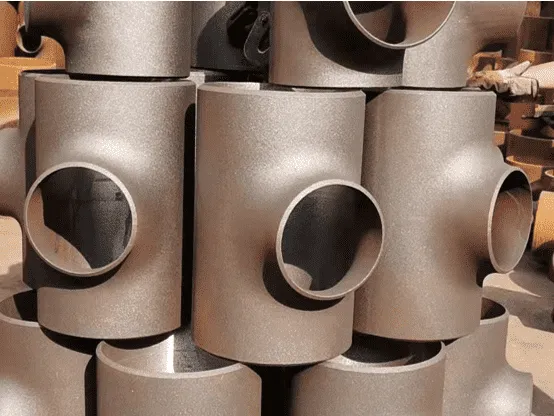
Hot press forming involves heating the tube
blank to a certain temperature to give it good plasticity, and then pressing it
through a die on a press to induce plastic deformation and form the shape of a
tee. This process utilizes the characteristic of increased plasticity of
materials at high temperatures, reducing deformation resistance and
facilitating tee forming.
Select suitable tube blank material and
size, and cut the blank. The requirements for tube blank material and cutting
are the same as for hydraulic bulging.
Place the tube blank in a heating furnace
for heating. The heating temperature depends on the material of the tube blank.
Generally, the heating temperature for carbon steel is 900-1100°C, and for stainless steel, it is 1050-1200°C.
Controlling the heating rate and time
ensures uniform heating of the tube blank, avoiding defects such as overheating
and burning.
Design and manufacture a die that matches
the shape and size of the tee. The die typically consists of a punch, a die,
and an ejector.
The die material should have good heat
resistance and wear resistance; commonly used materials include hot work die
steel.
Quickly place the heated tube blank into
the die cavity and position it accurately.
Install the ejector to remove the tee from
the die after forming.
Start the press, causing the punch to move
downwards and extrude the tube blank. During extrusion, the tube blank
undergoes plastic deformation under the action of the punch and die, gradually
forming the shape of the tee.
Controlling the extrusion speed and
pressure ensures smooth deformation of the tube blank while preventing defects
such as cracks and folds.
After the tube blank has deformed to a
certain extent, maintain the pressure for a period of time to allow the tee to
fully solidify. The pressure holding time depends on the material and thickness
of the tube blank.
During the pressure holding process, water
cooling or air cooling can be used to cool the tee, accelerating its forming
and hardening.
After pressure holding and cooling, the
press returns, and the ejector device ejects the tee from the mold.
Post-processing steps such as trimming,
heat treatment, and surface treatment are performed on the tee, with
requirements similar to those of the hydraulic bulging process.
3. Process Characteristics
Advantages: Hot pressing reduces the
deformation resistance of the material and improves its plasticity, making it
suitable for manufacturing tees of various materials; production efficiency is
relatively high, suitable for mass production.
Disadvantages: The heating process consumes
a lot of energy, resulting in higher production costs; the tube blank is prone
to oxidation during heating, affecting the surface quality of the tee; strict
control of heating temperature and extrusion parameters is required, otherwise
quality problems may occur.
1. Process Principle
Welding is the process of connecting
pre-fabricated pipe fittings (such as main pipes and branch pipes) together to
form a tee shape. Common welding methods include manual arc welding, gas
shielded welding, and submerged arc welding.
Prepare the main pipe and branch pipes
according to the tee's design requirements. The materials, dimensions, and wall
thickness of the main pipe and branch pipes should conform to relevant
standards.
Process the end faces of the main pipe and
branch pipes to ensure they are flat, perpendicular, and that the dimensional
accuracy of the end faces is guaranteed.
Assemble the branch pipes with the main pipe according to the design requirements, ensuring that the center lines of the branch pipes and main pipes are perpendicular and the gaps are uniform.
Use clamps or positioning devices to fix
the assembled pipe fittings to prevent displacement during welding.
Select the appropriate welding method and
welding materials according to the material of the pipe fittings and the
welding requirements. For example, for carbon steel pipe fittings, manual arc
welding or gas shielded welding can be used; for stainless steel pipe fittings,
argon arc welding is preferred.
Welding operations should be performed
according to the welding procedure specifications, controlling parameters such
as welding current, voltage, and welding speed to ensure weld quality. During
welding, attention should be paid to the weld formation and fusion to avoid
defects such as porosity, slag inclusions, and incomplete penetration.
After welding, the weld should be visually
inspected for defects such as cracks, porosity, and slag inclusions.
Non-destructive testing methods (such as
radiographic testing and ultrasonic testing) should be used to inspect the
internal quality of the weld to ensure it meets relevant standards.
The weld should be ground to remove spatter
and burrs, resulting in a smooth and even surface.
Heat treatment should be performed as
needed to eliminate residual welding stress and improve the mechanical
properties of the tee. The heat treatment method is similar to that used in
hydraulic bulging and hot pressing processes.
Surface treatments, such as anti-corrosion
treatment, should be applied to the tee to improve its corrosion resistance.
Advantages: Simple welding equipment and
low investment; high production flexibility, capable of manufacturing tees of
various specifications and shapes according to different design requirements;
suitable for manufacturing large-diameter, thick-walled tees.
Disadvantages: Welding defects are prone to
occur during the welding process, affecting the quality and reliability of the
tee; the mechanical properties of the weld may differ from the base material,
requiring special treatment and inspection.
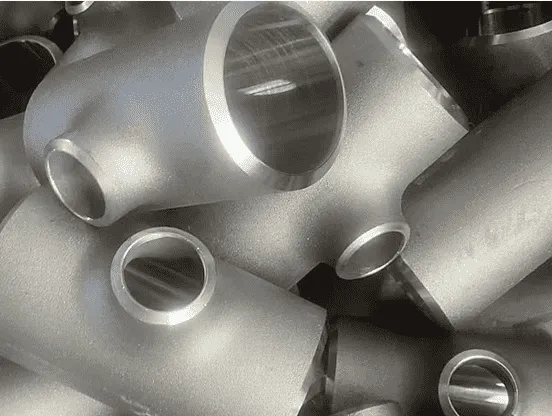
Machining uses machine tools such as
lathes, milling machines, and drilling machines to cut and process pipe blanks
or bars, gradually removing material to ultimately form the shape of the tee.
This process ensures the dimensional accuracy and surface quality of the tee
through precise tool movement and cutting parameter control.
Select suitable pipe blanks or bars as raw
materials, whose material and dimensions should meet the design requirements of
the tee.
Cutting the raw materials ensures accurate
dimensions and flat end faces.
The blanked material is fixed on a lathe
and turned to remove most of the excess material, giving the material the
initial outline of the tee.
During turning, cutting parameters must be
selected appropriately to ensure machining efficiency and tool life.
The tee is semi-finished after rough
machining to further improve dimensional accuracy and surface quality. Various
machining methods, such as turning and milling, can be used to perform detailed
machining on different parts of the tee.
Finish machining is performed to ensure the
tee's dimensional accuracy and surface roughness meet design requirements.
During finish machining, it is important to control cutting forces and heat to
avoid deformation and surface burns.
If the tee needs to connect to other pipe
fittings or equipment, drilling and tapping operations may be required.
According to design requirements, appropriate holes are drilled in the
corresponding positions on the tee and tapped to install bolts or nuts.
The finished tee undergoes dimensional,
shape, and surface quality inspections to ensure it meets relevant standards.
Post-processing steps such as deburring,
cleaning, and rust prevention are performed as needed.
Advantages: Machining produces tees with
high dimensional accuracy and good surface quality; it can manufacture tees
with complex shapes and high precision requirements; suitable for small-batch,
multi-variety production.
Disadvantages: Low material utilization
rate; a large amount of chips are generated during processing, resulting in
material waste; long processing cycle and relatively low production efficiency;
for large-diameter tees, processing is more difficult and requires advanced
equipment.
In summary, different tee manufacturing
processes each have their own advantages, disadvantages, and applicable scope.
In actual production, the appropriate manufacturing process should be selected
based on factors such as the tee's specifications, material, usage
requirements, and production volume to ensure that the tee's quality and
performance meet engineering needs.

Address:1177 Huanhu Road, Yuelu District, Changsha, Hunan, China
 WhatsApp
 WeChat