
 简体中文版
简体中文版

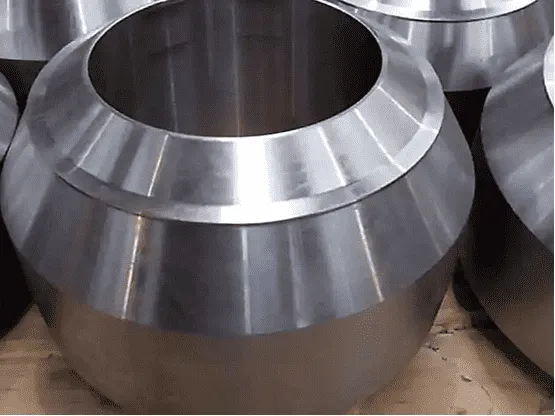
In short—a sockolet is similar to a welded joint, but its branch pipe connects to the main pipe through the joint.
Suitable for small-diameter branch pipes (generally ≤ 2")
Branch pipe ends are socket welded
Main pipe ends are butt welded or fillet welded
Commonly used in high-pressure, small-diameter, low-vibration systems
ASME B16.11
MSS-SP-97 (General Standard for Olet Fittings)
Carbon steel: A105 / A350 LF2
Stainless steel: 304 / 316
Alloy steel: F11 / F22
Faster installation, suitable for small-diameter branch pipes
Less welding work, reducing leakage risk
Highly suitable for high-pressure systems (Class 3000 / 6000 / 9000)
Welddolets are the most common branch pipe fittings, belonging to butt welded connections, and are available in a full range of sizes.
Both branch and main pipes are butt-welded.
Used for medium to large diameter branch pipe connections (2"–24" or above).
Weld strength is consistent with the base material, resulting in high load-bearing capacity.
ASME B16.9
MSS-SP-97
Carbon steel: A234 WPB
Stainless steel: 304 / 316
Low-temperature steel, alloy steel, etc.
High strength, able to withstand high pressure and high temperature
More uniform stress distribution
Can replace tees, reducing costs
|
Item |
Sockolet |
Weldolet |
|
Connection |
Socket Weld |
Butt Weld |
|
Applicable Diameter |
Class 3000 / 6000 / 9000 |
Medium to large diameter (2"–24"+) |
|
Pressure Rating |
Class 3000 / 6000 / 9000 |
SCH STD~XXS (depending on main pipe wall thickness) |
|
Strength |
Medium, higher than general socket joints |
Very high, close to the strength of the base material |
|
Welding Process Requirements |
Lower, easy to install |
Higher, requires skilled welders |
|
Applicable Operating Conditions |
High pressure, small diameter, low vibration |
High pressure, high temperature, large diameter |
|
Cost |
Higher (precision machining) |
Lower (widely used) |
|
Maintenance |
Fewer welds, lower risk |
Longer welds, higher welding quality requirements |
Insert the branch pipe into the socket;
Control the insertion gap (generally 1.6mm);
Perform fillet welds;
Weld the main body to the main pipe.
Drill a hole in the main pipe;
Align the Weldolet bevel with the main pipe;
Perform a full penetration butt weld;
Butt weld the branch pipe to the other end of the Weldolet.
Sockolet: Simpler installation, less welding required ⇒ Suitable for small-sized systems with high manifold pressure.
Weldolet: Requires skilled welders ⇒ More suitable for medium to large-sized, critical system piping.
Welded fittings have the advantage of welded connections, and therefore can generally withstand greater loads than socket fittings. Socket fittings rely solely on the friction of the gasket under the sleeve for sealing, which is suitable for lighter loads. However, for larger, heavier pipes and higher pressures, welded fittings provide a stronger and more durable load-bearing connection.
If you are a purchasing or engineering professional, you can quickly choose based on the following principles:
Branch pipe diameter ≤ 2"; High system pressure but small pipe diameter; Faster installation desired; Limited welding space.
Branch pipe diameter ≥ 2"; High temperature, high pressure, and highly corrosive systems; Requires a high strength rating for the base material; Oil, gas, boiler, and chemical applications.

Address:1177 Huanhu Road, Yuelu District, Changsha, Hunan, China
 WhatsApp
 WeChat