
 简体中文版
简体中文版

ASTM A36, developed by ASTM International, is a commonly used and widely applied carbon structural steel, belonging to the low-carbon steel category, and manufactured using a hot-rolling process. The main chemical components of A36 steel plate include carbon (C), copper (Cu), iron (Fe), manganese (Mn), phosphorus (P), silicon (Si), and sulfur (S). It possesses excellent weldability and is ideally suited for processes such as stamping, grinding, drilling, tapping, and machining. Unlike high-performance alloys, these properties of A36 steel plate enable its application in a variety of fields.
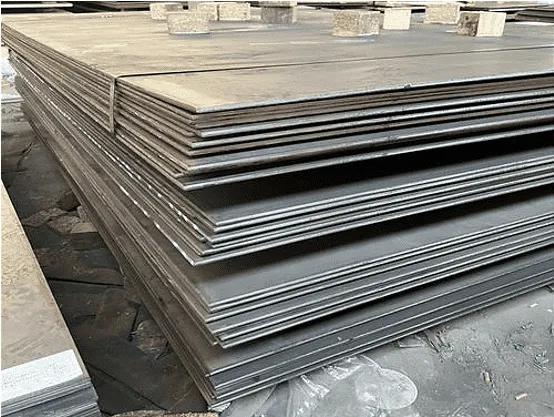
ASTM A36 is a standard low-carbon structural steel with typical characteristics including:
Suitable for various welding methods such as shielded metal arc welding (SMAW), gas shielded welding (GSAW), and submerged arc welding.
Suitable for stamping, bending, drilling, tapping, and other processing.
One of the most widely used structural steel grades globally.
Widely used in buildings, bridges, steel structural components, mechanical parts, etc.
|
Mechanical Properties Tensile and Yield Strength |
|
|
Tensile strength, ksi [MPa] |
58-80[400-550] |
|
Yield point, min, ksi [MPa] |
36[250] |
|
Elongation in 8 in. [200 mm], min, % |
20 |
|
Elongation in 2 in.[50 mm], min, % |
23 |
The chemical composition of A36 steel plate is as follows: Carbon (C) content 0.25%–0.29%, Copper (Cu) content 0.20%, Iron (Fe) content 98.0%, Manganese (Mn) content 1.03%, Phosphorus (P) content 0.04%, Silicon (Si) content 0.280%, and Sulfur (S) content 0.050%.
This steel plate has excellent properties and can be used for bolted connections, riveting, and welding in buildings, bridges, and other structural applications. It is suitable for various general structural uses.
|
Up to 3/4" Thick |
Content |
|
Carbon max |
0.25% |
|
Phosphorus max |
0.030% |
|
Sulfur max |
0.030% |
|
Silicon |
0.40% max |
|
Copper min |
0.20% |
|
Over 3/4" to 1 1/2" Thick |
Content |
|
Carbon max |
0.25% |
|
Manganese |
0.80-1.20% |
|
Phosphorus max |
0.030% |
|
Sulfur max |
0.030% |
|
Silicon |
0.40% max |
|
Copper min |
0.20% |
|
Over 1 1/2" to 2 1/2" Thick |
Content |
|
Carbon max |
0.26% |
|
Manganese |
0.80-1.20% |
|
Phosphorus max |
0.030% |
|
Sulfur max |
0.030% |
|
Silicon |
0.15-0.40% |
|
Copper min |
0.20% |
|
Over 2 1/2" to 4" Thick |
Content |
|
Carbon max |
0.27% |
|
Manganese |
0.85-1.20% |
|
Phosphorus max |
0.030% |
|
Sulfur max |
0.030% |
|
Silicon |
0.15-0.40% |
|
Copper min |
0.20% |
|
Over 4" Thick |
Content |
|
Carbon max |
0.29% |
|
Manganese |
0.85-1.20% |
|
Phosphorus max |
0.030% |
|
Sulfur max |
0.030% |
|
Silicon |
0.15-0.40% |
|
Copper min |
0.20% |
S275JR is most often considered a European structural steel closest to A36.
SS400 has properties very similar to A36.
Q235B / Q235A are low-carbon structural steels, similar in performance but with slightly lower strength.
ASTM A36 is the most widely used low-carbon structural steel globally, suitable for construction, bridges, machinery manufacturing, and general structural components. It is one of the most cost-effective structural steels in the engineering industry.

Address:1177 Huanhu Road, Yuelu District, Changsha, Hunan, China
 WhatsApp
 WeChat