
 简体中文版
简体中文版

Seamless steel pipes are widely used in high-safety-requirement fields such as oil and gas, boilers, power plants, chemical industry, high-pressure pipelines, and machinery manufacturing. Their quality directly affects the operational safety and service life of equipment. Therefore, establishing a scientific, systematic, and internationally standardized quality inspection system is a core aspect of seamless steel pipe production and export.
This article will comprehensively analyze the quality inspection methods and applicable standards for seamless steel pipes from multiple dimensions, including chemical composition, dimensions, surface and internal defects, mechanical properties, processing performance, and metallographic structure.
Chemical composition is the foundation for determining the mechanical properties, weldability, and corrosion resistance of seamless steel pipes and must strictly comply with relevant standards (such as ASTM, API, EN, and GB).
|
Project |
Equipment |
Element Detection |
|
Carbon and Sulfur Analysis |
Infrared C-S Analyzer |
C, S |
|
Alloy Element Analysis |
Direct Reading Spectrometer |
C, Si, Mn, P, S, Cr, Mo, Ni, Al, V, Ti, Nb, B, etc. |
|
Gas Analysis |
N-O Gas Analyzer |
N, O |
Tools: Micrometer, Ultrasonic Thickness Gauge, at least 8 points at both ends and record the readings.
Tools: Caliper Gauge, Vernier Caliper, Ring Gauge, measure the maximum and minimum points.
Tools: Steel Tape Measure, manual and automatic length measurement.
Tools: Ruler, Level (1m), Feeler Gauge, Fine Thread to measure bending per meter and overall bending.
Tools: Square, Special Caliper Plate.
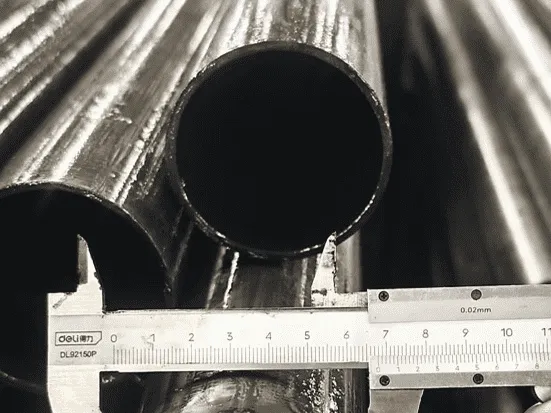
Lighting conditions, standards, experience, markings, and pipe rotation are required. The surface must be free of: cracks, folds, scale, severe scratches, pits, and indentations.
a. Ultrasonic Testing (UT): Highly sensitive to surface and internal cracks in various homogeneous materials.
b. Eddy Current Testing (ET): (Electromagnetic Induction): Primarily detects point-like (hole-like) defects.
c. Magnetic Particle Testing (MT) and Magnetic Flux Leakage Testing: Magnetic testing suitable for detecting surface and near-surface defects in ferromagnetic materials.
d. Electromagnetic Ultrasonic Testing: Requires no coupling medium and can be applied to high-temperature, high-speed, and rough steel pipe surfaces.
e. Penetrant Testing: Fluorescent and dye penetrant testing for detecting surface defects in steel pipes.
Measure stress and deformation to determine the material's strength (YS, TS) and plasticity (A, Z). Longitudinal and transverse specimens, pipe sections, arc-shaped, and circular specimens (¢10, ¢12.5). Gauge length determination for small-diameter, thin-walled, large-diameter, and thick-walled pipes.
CVN, notched C-type, V-type, energy J value (J/cm²).
Brinell hardness HB, Rockwell hardness HRC, Vickers hardness HV, etc.
Test pressure and holding time.
Circular specimens, C-shaped specimens (S/D>0.15). H=(1+2)S/(α +S/D)
L=40~100mm, deformation coefficient per unit length=0.07~0.08. Ring tensile test: L=15mm, no cracks are acceptable.
Mandrel taper is 30°, 40°, 60°.
Can replace the flattening test (for large diameters).
Non-metallic inclusions 100x GB/T 10561, grain size: grade, grade difference.
Microstructure: M, B, S, T, P, F, A-S.
Decarburized layer: inner, outer.
A-method rating: Class A - sulfides, Class B - oxides, Class C - silicates, Class D - spherical oxides, Class DS.
Macroscopic analysis: Naked eye, magnifying glass below 10×.
a. Acid etching test.
b. Sulfur print inspection method (for billet inspection, showing low-magnification microstructure and defects such as porosity, segregation, subcutaneous bubbles, flaking, white spots, inclusions, etc.)
c. Tower-shaped hairline crack inspection method: inspects the number, length, and distribution of hairline cracks.
ASTM: ASTM A106, A53, A179
API: API 5L, API 5CT
EN: EN 10210, EN 10216
GB: GB/T 8162, GB/T 8163
Repairable defects: Grind, straighten, re-inspect;
Performance not meeting standards: Downgrade or scrap;
Serious defects: Strictly prohibited from entering the market.
Ultrasonic testing typically includes chemical composition, dimensional and surface inspection, mechanical property testing, hydrostatic testing, and non-destructive testing (UT/ET), performed according to ASTM/API/EN/GB standards.
Not all. Random sampling is generally acceptable for industrial applications, but high-pressure, boiler, and oil and gas pipes typically require 100% UT or ET testing.

Address:1177 Huanhu Road, Yuelu District, Changsha, Hunan, China
 WhatsApp
 WeChat