
 简体中文版
简体中文版

In the manufacturing process of the LSAW steel pipe(Longitudinal Submerged Arc Welded Steel Pipe), the forming process directly determines the dimensional accuracy, mechanical properties, production efficiency, and cost structure of the steel pipe.
Currently, the most mature and representative forming methods in industrial applications mainly include UOE, JCOE, and HME, among which UOE and JCOE are the mainstream choices in international pipeline projects. This article will systematically compare and analyze UOE and JCOE LSAW steel pipes from multiple dimensions, including forming principles, process flow, technical characteristics, specification range, application scenarios, and selection.
LSAW steel pipes can be classified into the following types according to different forming methods:
After pre-bending the edges of a single steel plate, it undergoes U-forming, O-forming, internal welding, external welding, and mechanical cold expansion processes in sequence.
Pre-welded and formed in the sequence "J-C-O-E," followed by cold expansion after welding.
Formed using a mandrel rolling method in the sequence "C-C-O," followed by cold expansion after welding.
The UOE steel pipe forming process is completed in three steps: pre-bending the edges, U-shaped press forming, and O-shaped press forming, with cold expansion of the entire pipe at the end.
U-forming: The steel plate is bent into a "U" shape using a hydraulic press.
O-forming: The "U" shape is further pressed into a circular "O" shape.
Diameter Expansion: The pipe diameter is expanded to the final diameter using mechanical or hydraulic methods, ensuring uniform dimensions and eliminating residual stress.
This forming unit is large and expensive. Each forming unit requires multiple sets of internal and external welding machines, resulting in high production efficiency.
The forming and welding processes are separated, making it a non-continuous, single-piece production process.
It can produce thick-walled LSAW steel pipes, with a maximum wall thickness of approximately 40mm.
The weld length of LSAW steel pipes is only half that of spiral welded pipes for the same length, reducing the probability of weld defects.
High output; the output of one UOE unit is generally equivalent to the total output of 2-4 spiral welded pipe units.
The diameter expansion process improves the strength and dimensional accuracy of the steel pipe.
UOE steel pipes have straight seams, making pipeline laying and maintenance easier.
The equipment is larger than spiral welded pipe units, resulting in higher investment costs.
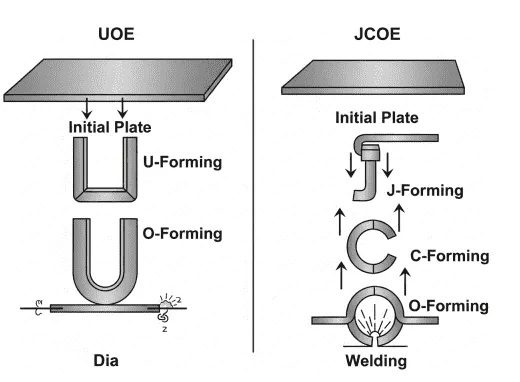
JCOE forming has three stages: first, the steel plate is pressed into a J-shape, then successively into a C-shape and an O-shape, where E represents diameter expansion.
J-Shaping: The steel plate is bent into a "J" shape using a hydraulic press;
C-Shaping: The "J" shape is further bent into a "C" shape under pressure;
O-Shaping: The "C" shape is bent into a circular "O" shape, forming the basic shape of the pipe body;
Flanging: The O-shaped blank is welded internally and externally to form a complete weld seam.
The JCOE forming pipe-making unit is developed based on the UOE forming process. It borrows the working principle of the U-shape and implements the UOE forming process, significantly reducing the tonnage of the forming machine and thus saving on equipment investment.
The produced steel pipes are of the same quality as UOE welded pipes, but the output is lower than that of UOE welded pipe units. This process easily achieves automated control during forming, resulting in better product forming quality. JCOE forming equipment can be broadly divided into two types: bending forming and compression molding.
Each forming step in JCOE is completed on a large press. LSAW steel pipe shaping requires high technical skills, and the forming unit has a long occupancy time.
Due to the multiple forming processes, the processing efficiency is lower compared to the UOE process, but fewer molds are needed, resulting in lower equipment investment.
Because JCOE involves multi-step pressing, the dimensional accuracy of LSAW steel pipes is lower than that of UOE. Therefore, UOE steel pipes are more commonly used in marine pipelines.
Advantages
Extremely high production efficiency and output per unit time; stable product dimensions and excellent quality; perfectly meets the urgent needs of large-scale pipeline projects for standardized LSAW steel pipes.
Limitations
Significant equipment investment leads to higher production costs for small-batch orders; inflexible production size switching, unsuitable for small-batch, multi-specification orders.
Specifications
|
UOE LSAW Pipe |
|
Outside Diameter:Φ508mm - 1118mm (20"- 44") |
|
Wall Thickness: 6.0 - 25.4mm 1/4"-1" |
|
Quality Standards: API、DNV、ISO、DEP、EN、ASTM、DIN、BS、JIS、GB、CSA |
|
Length: 9 - 12.3m (30'- 40') |
|
Grades: API 5L A-X90, GB/T9711 L190-L625 |
Typical Applications
Long-distance Oil and Gas Pipelines: Major domestic and international projects (e.g., transnational natural gas pipelines).
Subsea Pipelines: Offshore projects with stringent requirements for quality consistency and delivery speed.
Large mud pipelines.
Advantages
Flexible manufacturing process, easily producing non-standard sizes and large-diameter LSAW steel pipes; low mold cost and setup cost, suitable for small-batch orders; best suited for customized specifications.
Limitations
Lower production efficiency, not suitable for urgent large-scale projects; high product precision requirements necessitate the use of advanced equipment.
Specifications
|
JCOE LSAW Pipe |
|
Outside Diameter:Φ406mm - 1626mm (16" - 64" ) |
|
Wall Thickness:6.0 - 75mm (1/4" - 3" ) |
|
Quality Standards:API、DNV、ISO、DEP、EN、ASTM、DIN、BS、JIS、GB、CSA |
|
Length:3 - 12.5m ( 10'- 41' ) |
|
Grades:API 5L A-X100, GB/T9711 L190-L690 |
Typical Applications
Structural Piping: Airports, stadiums, bridges, and high-rise building foundations.
Process Piping: Used in power plants and petrochemical facilities. Water and heating networks (urban infrastructure).
Offshore platform structures.
When choosing an LSAW steel pipe manufacturing process, engineers or purchasing managers should consider the following factors:
If you need tens or hundreds of thousands of tons of piping of a single specification, the UOE process is more economical. If you only need a few thousand tons or a small number of different specifications of piping, the JCOE process is more ideal.
While they can indeed produce piping that meets standards and well-known grade standards (such as API 5L), JCOE is often the only option for a single diameter or wall thickness specification designed for a specific structure.
An attractive feature of UOE is its ability to be mass-produced, thus reducing unit costs and speeding up delivery. JCOE is characterized by lower investment and is more suitable for customers with limited cost budgets or order volumes.

Address:1177 Huanhu Road, Yuelu District, Changsha, Hunan, China
 WhatsApp
 WeChat