
 简体中文版
简体中文版

LSAW pipe is an important industrial pipe material with wide applications in many fields. The manufacturing process of LSAW pipe involves several key steps, such as raw material preparation, steel plate pretreatment, forming, welding, flaw detection, heat treatment, and finishing. Below is a detailed introduction.
Raw materials are the foundation of LSAW
pipe production. Generally, high-quality steel plates are selected as raw
materials, and these steel plates need to possess good mechanical and
weldability.
Before production, the steel plates undergo
rigorous inspection to check for defects such as cracks and pinholes on the
surface. Simultaneously, their chemical composition and mechanical properties
are analyzed to ensure they meet production requirements. Only high-quality raw
materials can produce high-quality LSAW pipes.
Steel plate pretreatment is a crucial step
in ensuring welding quality.
First, the steel plates are leveled to
eliminate internal stress and unevenness generated during the rolling process,
resulting in a smooth surface. Then, rust removal treatment is performed to
remove oxide scale, rust, and other impurities from the steel plate surface.
Common rust removal methods include shot
blasting and pickling. Shot blasting is highly efficient, pollution-free, and
widely used. The surface of the steel plate after rust removal should achieve a
certain level of cleanliness and roughness to facilitate subsequent welding.
Forming is the process of shaping the
pre-treated steel plate into a tubular shape. Common forming methods include
UOE forming and JCOE forming.
The steel plate is first pressed into a
U-shape on a U-press, then into an O-shape on an O-press, and finally expanded
in diameter. This forming method has high production efficiency and good pipe
diameter accuracy and roundness, but requires a large investment in equipment.
Through multiple step-pressing processes,
the steel plate is gradually pressed into a J-shape, then a C-shape, and
finally an O-shape. JCOE forming equipment is relatively simple, requires less
investment, and is suitable for multi-specification, small-batch production.
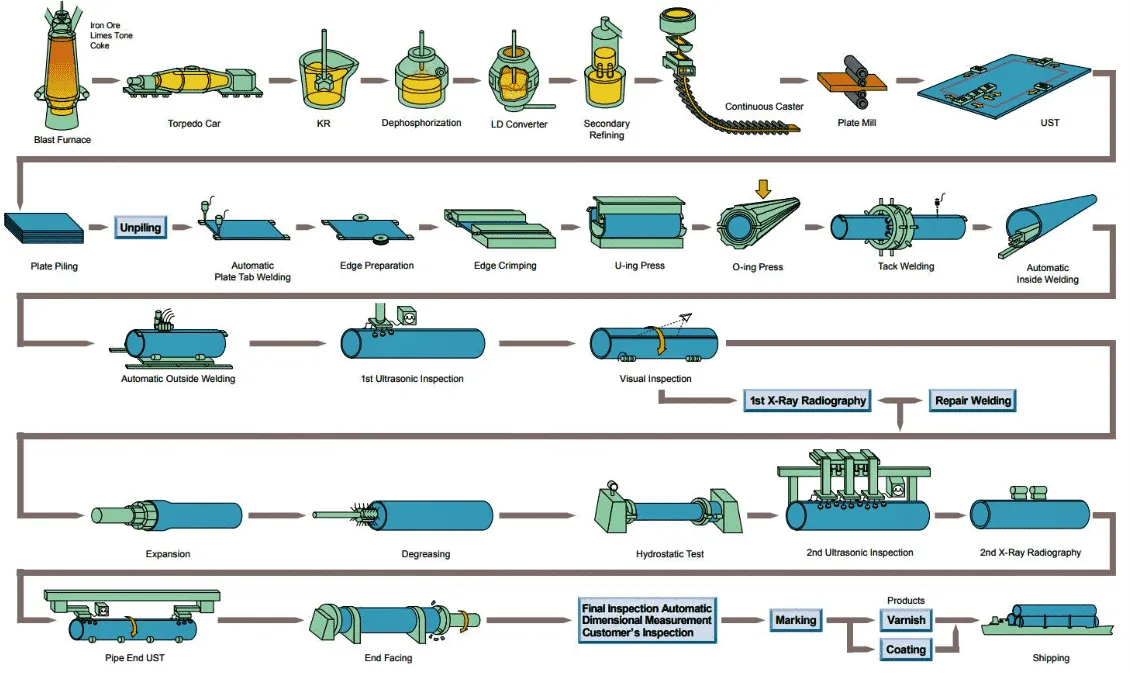
Welding is the core step in LSAW pipe
production. Submerged arc welding (SAW) is used to weld the formed pipe blank.
SAW is a welding method where an electric arc burns under a layer of flux,
offering advantages such as high weld quality, high production efficiency, and
good working conditions.
The bevel of the pipe blank must be cleaned
and processed to ensure that the bevel size and angle meet requirements.
Simultaneously, appropriate welding materials and welding process parameters,
such as welding current, voltage, and welding speed, must be selected.
Welding quality must be strictly controlled
to prevent welding defects such as porosity, cracks, and lack of fusion.
Double-sided SAW is generally used, welding the inner weld first, then the
outer weld. Welding parameters must be monitored in real time during the
welding process to ensure stable weld quality.
To ensure the quality of LSAW pipes,
rigorous flaw detection is required after welding. Commonly used flaw detection
methods include ultrasonic testing, radiographic testing, and magnetic particle
testing.
Ultrasonic testing is mainly used to detect
internal defects in the weld, such as porosity and cracks. It has the
advantages of fast detection speed and high sensitivity.
Radiographic testing can clearly show the
morphology and location of defects inside the weld, and the test results are
intuitive and reliable. However, the testing cost is high, and there is a
certain radiation hazard.
Magnetic particle testing is mainly used to
detect defects on and near the surface of the weld and is suitable for the
testing of ferromagnetic materials.
For some applications with high performance
requirements for LSAW pipes, heat treatment is required after welding. The
purpose of heat treatment is to eliminate welding stress and improve the
microstructure and mechanical properties of the steel pipe. Common heat
treatment methods include normalizing, tempering, and quenching and tempering.
Normalizing involves heating the LSAW pipe
to a certain temperature, holding it at that temperature for a certain time,
and then cooling it in air. Normalizing can refine the grains and improve the
strength and toughness of the steel pipe.
Tempering is a heat treatment process
performed after normalizing or quenching. It can eliminate internal stress and
reduce the brittleness of the steel pipe.
Quenching and tempering is a composite heat
treatment process involving quenching and high-temperature tempering, which
enables the steel pipe to acquire excellent comprehensive mechanical
properties.
Finishing is the final processing and
treatment of the heat-treated steel pipe. This includes cutting the steel pipe
to the required length to meet standard requirements; flattening and chamfering
the ends of the steel pipe to facilitate subsequent connection and
installation; and painting and anti-corrosion treatment of the steel pipe
surface to improve its corrosion resistance.
Through the above series of production
processes, the LSAW pipe is produced. Each step is crucial; only by strictly
controlling the quality of each step can high-quality LSAW pipes be produced to
meet the needs of different fields.

Address:1177 Huanhu Road, Yuelu District, Changsha, Hunan, China
 WhatsApp
 WeChat