
 简体中文版
简体中文版

Seamless steel pipes are an important industrial material, and their performance directly affects their safety and service life. Heat treatment is a crucial step in improving the mechanical properties and microstructure of seamless steel pipes. The main heat treatment processes include normalizing, quenching, tempering, and annealing. The main steps and technical points of heat treatment for seamless steel pipes will be detailed below.
Before heat treatment, the seamless steel pipes must undergo rigorous inspection, including chemical composition analysis, dimensional measurement, and surface defect inspection, to ensure that the material meets the heat treatment requirements.
Remove oil, scale, and other impurities from the surface of the seamless steel pipes to prevent uneven heating or surface defects during heat treatment. Common methods include alkaline washing, acid washing, or mechanical cleaning.
Based on the steel pipe specifications and heat treatment requirements, the furnace loading method and support structure should be rationally designed to ensure uniform heating and prevent deformation.
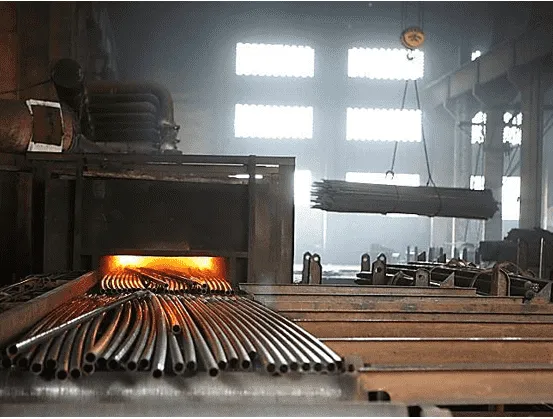
Heat the seamless steel pipe to 30-50°C above its critical temperature (Ac3 or Acm). Typically, this is 880-950°C for carbon steel and may be higher for alloy steel. The heating rate should be controlled at 100-150°C/h, and slower for larger pipes.
Determine the holding time based on the seamless steel pipe's wall thickness, generally calculated at 1.5-2.5 minutes/mm, to ensure complete austenitization.
Allow the pipe to cool naturally in still air at a uniform rate. For steel pipes with high alloy content, the cooling rate may need to be controlled.
Similar to normalizing, but the temperature is typically 20-30°C higher to ensure complete austenitization. Higher temperatures may be required for high-alloy steels.
The holding time is slightly longer than normalizing to ensure sufficient dissolution of carbides and homogenization of composition.
Use water, oil, or polymer solutions as the quenching medium. The cooling rate must be fast enough to suppress the pearlite transformation and obtain a martensitic structure. Care must be taken to control the uniformity of cooling to prevent deformation and cracking.
Heat the quenched steel pipe to a temperature below Ac1 (usually 150-650℃), the specific temperature depending on the steel grade and performance requirements.
|
Item |
Temperature |
Functions |
|
Low-temperature tempering |
150-250℃ |
Reduces internal stress and maintains high hardness; suitable for tool steels. |
|
Medium-temperature tempering |
350-500℃ |
Improves the elastic limit; suitable for spring steels. |
|
High-temperature tempering |
500-650℃ |
Comprehensively improves strength and toughness, eliminates quenching brittleness; suitable for structural steels. |
The holding time is generally 1-2 hours; thick-walled seamless steel pipes require a longer time to ensure temperature uniformity.
Typically, cooling is performed in air. For steels with temper brittleness, rapid cooling through the brittle temperature range may be necessary.
Heating to 30-50°C above Ac3, holding at that temperature, and then slowly cooling (furnace cooling) is used to refine grains and relieve stress.
Heating to between Ac₁ and Ac₃ is used for hypereutectoid steels to reduce network carbides.
Heating to near Ac1 and holding for a long time causes carbides to spheroidize, improving machinability.
Heating to 500-650°C, holding at that temperature, and then slowly cooling is mainly used to eliminate residual stress generated by cold working or welding.
A combination of quenching and high-temperature tempering achieves a good balance of strength and toughness, commonly used for high-strength seamless steel pipes.
For seamless austenitic stainless steel tubes, heat to 1050-1150°C and rapidly cool to dissolve carbides and improve corrosion resistance.
For austenitic stainless steel containing Ti and Nb, hold at 850-930°C and then air cool to stabilize the microstructure.
Seamless steel pipes may deform after heat treatment and require straightening.
Including ultrasonic testing and eddy current testing to check the internal quality of the heat-treated steel tubes.
Samples are taken for tensile, impact, and hardness tests to ensure compliance with standards.
Depending on the application requirements, surface treatments such as shot peening, phosphating, or oiling may be necessary.
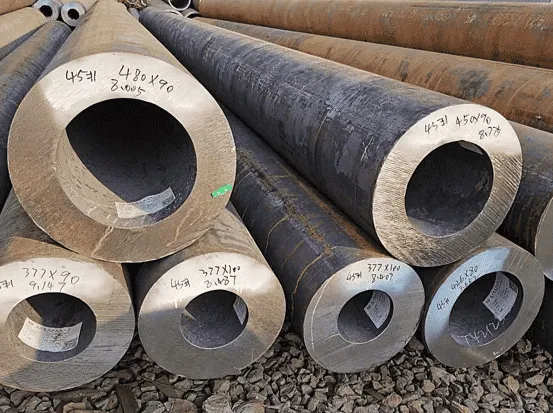
The temperature uniformity of the heating furnace should be controlled within ±10°C, with even greater precision required during critical stages.
Holding time must be sufficient but not excessive to prevent grain coarsening or decarburization.
Cooling rate and uniformity directly affect microstructure transformation and must be strictly controlled according to steel grade.
Ensure dimensional accuracy through proper furnace loading, support, and the use of straightening equipment.
Prevent oxidation and decarburization by using a protective atmosphere or vacuum heat treatment.
May be due to insufficient heating temperature, insufficient holding time, or excessively slow cooling rate; process parameters need adjustment.
Optimize furnace loading, use specialized fixtures, and add a straightening process if necessary.
Control heating and cooling rates to avoid stress concentration; special attention is needed for high-carbon steels.
Ensure uniform heating and appropriately extend holding time.
Use a protective atmosphere or vacuum heat treatment, or perform subsequent pickling.
In summary, the heat treatment process for seamless steel pipes is a systematic project. It requires a scientifically formulated process plan based on the material composition, dimensions, and final application requirements, and strict control of each step to achieve the desired microstructure and properties. With technological advancements, intelligent heat treatment equipment and process simulation technology are being increasingly widely applied in the field of seamless steel pipe heat treatment.

Address:1177 Huanhu Road, Yuelu District, Changsha, Hunan, China
 WhatsApp
 WeChat