
 简体中文版
简体中文版

Pipe tees, also known as pipe fittings or T-joints, are used to change the direction of fluid flow and branch off from the main pipe. Generally, pipe tees are divided into reducing tees and equal tees, playing different roles in fluid distribution systems. This article will discuss the dimensions, classifications, characteristics, and applications of equal and reducing tees, providing a comprehensive comparison.
A reducing tee has three ports with different diameters, also called a decreasing tee. The branch pipe diameter is smaller, which can increase the pressure of the medium in the branch pipe.
Welded reducing tees are suitable for applications in piping systems where pipe diameter needs to be changed to maintain a stable connection.
Flange reducing tees are suitable for flange connections in piping systems that require connecting pipes of different diameters.
Threaded reducing tees are suitable for small to medium-sized piping systems and can connect pipes of different diameters.
The choice of these classifications depends on the specific needs and characteristics of the piping system. For example, welded reducing tees are suitable for high-pressure, high-temperature environments, while flange connections are suitable for applications requiring frequent disassembly and replacement.
On the other hand, threaded connections are more suitable for small to medium-sized, low-pressure piping systems. Reducing tees are typically used when it is necessary to change the direction of fluid flow or the pipe diameter to meet system design and operational requirements.
The main pipe has two outlets of the same size, while the third branch has a smaller diameter.
Allows for changing pipe size and reducing flow rate in branches, ideal for systems requiring different flow rates or pressure reduction in one branch.
Enables smooth transitions between different pipe sizes without the need for additional reducers or adapters.
|
Nominal Size |
Pipe O.D |
Working Pressure |
Dimensions |
Certificate |
||
|
mm/in |
mm/in |
PSI/Mpa |
L (mm/in) |
L1(mm/in) |
||
|
50 × 25 |
60.3 × 33.7 |
300PSI |
363PSI |
55 |
63 |
|
|
2 × 1 |
2.375 × 1.315 |
2.165 |
2.480 |
|||
|
50 × 32 |
60.3 × 42.4 |
59 |
63 |
|||
|
2 × 1¼ |
2.375 × 1.660 |
2.323 |
2.480 |
|||
|
50 × 40 |
60.3 × 48.3 |
62 |
63 |
|||
|
2 × 1½ |
2.375 × 1.900 |
2.441 |
2.480 |
|||
|
65 × 40 |
76.1 × 48.3 |
62 |
74 |
|||
|
2½ × 1½ |
3.000 × 1.900 |
2.441 |
2.913 |
|||
|
65 × 50 |
76.1 × 60.3 |
66.5 |
74 |
|||
|
2½ × 2 |
3.000 × 2.375 |
2.618 |
2.913 |
|||
|
80 × 50 |
88.9 × 60.3 |
68.5 |
84 |
FM UL |
||
|
3 × 2 |
3.500 × 2.375 |
2.697 |
3.307 |
|||
|
80 × 65 |
88.9 × 76.1 |
74 |
84 |
FM UL 3C |
||
|
3 × 2½ |
3.500 × 3.000 |
2.913 |
3.307 |
|||
|
100 × 50 |
108.0 × 60.3 |
68.5 |
96 |
|||
|
4 × 2 |
4.250 × 2.375 |
2.697 |
3.780 |
|||
|
100 × 65 |
108.0 × 76.1 |
74 |
96 |
|||
|
4 × 2½ |
4.250 × 3.000 |
2.913 |
3.780 |
|||
|
100 × 80 |
108.0 × 88.9 |
84 |
96 |
|||
|
4 × 3 |
4.250 × 3.500 |
3.307 |
3.780 |
|||
|
100 × 40 |
114.3 × 48.3 |
66 |
97 |
FM UL |
||
|
4 × 1½ |
4.500 × 1.900 |
2.598 |
3.819 |
|||
|
100 × 50 |
114.3 × 60.3 |
68.5 |
96 |
FM UL |
||
|
4 × 2 |
4.500 × 2.375 |
2.697 |
3.780 |
|||
|
100 × 65 |
114.3 × 76.1 |
74 |
96 |
FM UL 3C |
||
|
4 × 2½ |
4.500 × 3.000 |
2.913 |
3.780 |
|||
|
100 × 80 |
114.3 × 88.9 |
84 |
96 |
FM UL 3C |
||
|
4 × 3 |
4.500 × 3.500 |
3.307 |
3.780 |
|||
|
125 × 65 |
133.0 × 76.1 |
74 |
113 |
|||
|
5 × 2½ |
5.250 × 3.000 |
2.913 |
4.449 |
|||
|
125 × 80 |
133.0 × 88.9 |
84 |
113 |
|||
|
5 × 3 |
5.250 × 3.500 |
3.307 |
4.449 |
|||
|
125 × 100 |
133.0 × 108.0 |
98 |
113 |
|||
|
5 × 4 |
5.250 × 4.250 |
3.858 |
4.449 |
|||
|
125 × 100 |
133.0 × 114.3 |
98 |
113 |
|||
|
5 × 4 |
5.250 × 4.500 |
3.858 |
4.449 |
|||
|
125 × 65 |
139.7 × 76.1 |
74 |
113 |
FM UL |
||
|
5 × 2½ |
5.500 × 3.000 |
2.913 |
4.449 |
|||
|
125 × 80 |
139.7 × 88.9 |
84 |
113 |
FM UL |
||
|
5 × 3 |
5.500 × 3.500 |
3.307 |
4.449 |
|||
|
125 × 100 |
139.7 × 114.3 |
98 |
113 |
FM UL 3C |
||
|
5 × 4 |
5.500 × 4.500 |
3.858 |
4.449 |
|||
|
150 × 65 |
159.0 × 76.1 |
74 |
122 |
|||
|
6 × 2½ |
6.250 × 3.000 |
2.913 |
4.803 |
|||
|
150 × 80 |
159.0 × 88.9 |
84 |
122 |
|||
|
6 × 3 |
6.250 × 3.500 |
3.307 |
4.803 |
|||
|
150 × 100 |
159.0 × 108.0 |
98 |
122 |
|||
|
6 × 4 |
6.250 × 4.250 |
3.858 |
4.803 |
|||
|
150 × 100 |
159.0 × 114.3 |
102 |
122 |
FM UL 3C |
||
|
6 × 4 |
6.250 × 4.500 |
4.016 |
4.803 |
|||
|
150 × 125 |
159.0 × 133.0 |
111 |
122 |
|||
|
6 × 5 |
6.250 × 5.250 |
4.370 |
4.803 |
|||
|
150 × 125 |
159.0 × 139.7 |
114 |
128 |
|||
|
6 × 5 |
6.250 × 5.500 |
4.488 |
5.039 |
|||
|
150 × 65 |
165.1 × 76.1 |
78 |
126 |
FM UL 3C |
||
|
6 × 2½ |
6.500 × 3.000 |
3.071 |
4.961 |
|||
|
150 × 80 |
165.1 × 88.9 |
84 |
126 |
FM UL |
||
|
6 × 3 |
6.500 × 3.500 |
3.307 |
4.961 |
|||
|
150 × 100 |
165.1 × 114.3 |
102 |
122 |
FM UL 3C |
||
|
6 × 4 |
6.500 × 4.500 |
4.016 |
4.803 |
|||
|
150 × 125 |
165.1 × 139.7 |
114 |
128 |
FM UL |
||
|
6 × 5 |
6.500 × 5.500 |
4.488 |
5.039 |
|||
|
200 × 65 |
219.1 × 76.1 |
87.5 |
155 |
FM UL |
||
|
8 × 2½ |
8.625 × 3.000 |
3.445 |
6.102 |
|||
|
200 × 80 |
219.1 × 88.9 |
94.5 |
155 |
FM UL |
||
|
8 × 3 |
8.625 × 3.500 |
3.720 |
6.102 |
|||
|
200 × 100 |
219.1 × 108.0 |
103 |
149 |
|||
|
8 × 4 |
8.625 × 4.250 |
4.055 |
5.866 |
|||
|
200 × 100 |
219.1 × 114.3 |
103 |
149 |
FM UL 3C |
||
|
8 × 4 |
8.625 × 4.500 |
4.055 |
5.866 |
|||
|
200 × 125 |
219.1 × 133.0 |
118 |
156 |
|||
|
8 × 5 |
8.625 × 5.250 |
4.646 |
6.142 |
|||
|
200 × 125 |
219.1 × 139.7 |
118 |
156 |
|||
|
8 × 5 |
8.625 × 5.500 |
4.646 |
6.142 |
|||
|
200 × 150 |
219.1 × 159.0 |
124 |
158 |
FM UL |
||
|
8 × 6 |
8.625 × 5.500 |
4.882 |
6.220 |
|||
|
200 × 150 |
219.1 × 165.1 |
133 |
158 |
FM UL |
||
|
8 × 6 |
8.625 × 6.500 |
5.236 |
6.220 |
|||
|
250 × 100 |
273.0 × 114.3 |
225PSI |
136 |
186 |
||
|
10 × 4 |
10.75 × 4.250 |
5.354 |
7.323 |
|||
|
250 × 150 |
273.0 × 165.1 |
136 |
186 |
|||
|
10 × 6 |
10.75 × 6.500 |
5.354 |
7.323 |
|||
|
250 × 200 |
273.0 × 219.1 |
165 |
190 |
|||
|
10 × 8 |
10.750 × 8.625 |
6.496 |
7.480 |
|||
|
300 × 200 |
323.9 × 219.1 |
165 |
215 |
|||
|
12 × 8 |
12.750 × 8.625 |
6.496 |
8.465 |
|||
|
300 × 250 |
323.9 × 273.0 |
192 |
215 |
UL |
||
|
12 × 10 |
12.750 × 10.750 |
7.559 |
8.465 |
|||
An equal tees (also called a straight tee) is a pipe fitting with three outlets of the same diameter. All three connection points, including the main pipe and branch pipes, are the same size, ensuring consistent flow rate across all branch pipes.
Uses welded connections, suitable for applications requiring stable connections and high strength, such as high-pressure and high-temperature environments.
Uses flange connections, suitable for applications requiring frequent disassembly, providing more flexible installation and maintenance options.
Uses threaded connections, easy to install, suitable for small to medium-sized piping systems, requiring no welding.
All three outlets have the same diameter, facilitating stable flow rate.
Used for branching in piping systems, ensuring uniform distribution of fluid or gas at the branch points.
Ensures that the flow rate at the branch points does not change or decrease, thus maintaining stable pressure and flow velocity.
|
Nominal Size |
Pipe O.D |
Working Pressure |
Dimensions |
Certificate |
|
|
mm/in |
mm/in |
PSI/Mpa |
L (mm/in) |
||
|
50 |
60.3 |
300PSI |
363PSI |
68.5 |
FM UL 3C |
|
2 |
2.374 |
2.697 |
|||
|
65 |
76.1 |
74 |
FM UL 3C |
||
|
2½ |
2.996 |
2.913 |
|||
|
80 |
88.9 |
84 |
FM UL 3C |
||
|
3 |
3.500 |
3.307 |
|||
|
100 |
108.0 |
100 |
FM UL |
||
|
4 |
4.252 |
3.937 |
|||
|
100 |
114.3 |
100 |
FM UL 3C |
||
|
4 |
4.500 |
3.937 |
|||
|
125 |
133.0 |
122 |
|||
|
5 |
5.236 |
4.803 |
|||
|
125 |
139.7 |
122 |
FM UL 3C |
||
|
5 |
5.500 |
4.803 |
|||
|
150 |
159.0 |
138 |
FM UL 3C |
||
|
6 |
6.260 |
5.433 |
|||
|
150 |
165.1 |
138 |
FM UL 3C |
||
|
6 |
6.500 |
5.433 |
|||
|
200 |
219.1 |
171 |
FM UL 3C |
||
|
8 |
8.626 |
6.732 |
|||
|
250 |
273.0 |
212 |
|||
|
10 |
10.748 |
8.346 |
|||
|
300 |
323.9 |
242 |
|||
|
12 |
12.752 |
9.528 |
|||
|
250 |
273.0 |
225PSI |
363PSI |
212 |
UL |
|
10 |
10.748 |
8.346 |
|||
|
300 |
323.9 |
242 |
UL |
||
|
12 |
12.752 |
9.528 |
|||
Equal Tee: All three outlets have the same diameter, ensuring uniform flow throughout the system.
Reducing Tee: Branch outlet diameter is smaller than the main pipe, allowing flow or pressure to be reduced to a specific part of the system.
Equal Tee: Fluid flow remains constant at all three outlets, providing uniform distribution without altering flow or pressure.
Reducing Tee: Smaller branches can reduce flow or pressure, making it ideal for applications requiring the diversion of fluid to smaller pipes or systems.
Equal Tee: Primarily used where maintaining consistent flow at all outlets is crucial, typically in systems where balance and uniformity are critical.
Reducing Tee: Used for situations requiring the connection of pipes of different sizes and managing varying flow rates within the system.
Equal Tee: Specifications are typically expressed in uniform diameters, such as "T3" indicating an equal tee with an outside diameter of 3 inches.
Reducing Tees: Two or three different diameters need to be specified simultaneously, such as "T4×4×3.5" indicating a reducing tee with a 4-inch diameter and a 3.5-inch diameter.
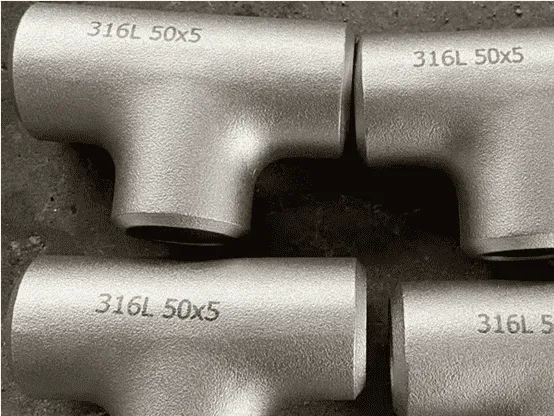
Equal Tees: Their symmetrical structure gives them excellent load distribution capabilities. Pressure vessel specifications show that under internal pressure, the stress concentration factor of equal tees is typically between 2.0 and 2.5, and the stress distribution exhibits a regular circumferential pattern.
This makes them particularly suitable for high-pressure conditions, such as the 32MPa high-pressure pipelines in ammonia synthesis plants.
Reducing Tees: Exhibit significant anisotropy. Finite element analysis results show that a three-dimensional stress state appears in the transition region at the connection between the main pipe and branch pipe, with the maximum stress point often appearing at the small radius of curvature on the branch pipe side.
Fatigue test data reveals that the lifespan of reducing tees under cyclic loading is typically 30% shorter than that of equal tees, requiring additional strength compensation in nuclear-grade piping designs.
Equal Tees: Commonly used in systems requiring uniform flow distribution, such as HVAC, water supply and drainage, and industrial fluid control systems.
Reducing Tees: Suitable for systems requiring reduced flow in a single branch line, therefore suitable for water supply, gas distribution, and irrigation systems.
Equal Tees: Easy to install because all outlet sizes are the same, meaning fewer components are required during installation.
Reducing Tees: Slightly more complex to install because they involve pipes of different sizes, requiring precise alignment and flow calculations to ensure proper pressure and flow control.
Due to their greater flexibility and wider range of applications, reducing tees may be used more frequently in piping systems that require connecting pipes of different diameters. However, in specific situations, such as when connecting pipes of the same diameter, equal tees are the indispensable choice.
Here are some tips to help you correctly distinguish between reducing and equal tees.
The branch pipes of a reducing tee are usually smaller or larger than the main pipe and have larger bends or angles. Equal tees have branch pipes with the same diameter as the main pipe and are often straight or have a small angle. Visually, it's easy to quickly distinguish between a reducing tee and an equal tee.
Reducing tees and equal tees are usually marked with different symbols. Reducing tees typically have a number indicating the diameter of the branch pipe, while equal tees do not. This marking also allows for quick identification.
Equal tees, with their simple structure and good sealing and pressure resistance, are the preferred choice for pipe joining or branching; while reducing tees, with their flexible connection methods and wide range of applications, play an important role in pipe branching connections. In practical applications, the appropriate tee type should be selected based on specific needs and scenarios to ensure the stable operation and efficient functioning of the pipeline system.

Address:1177 Huanhu Road, Yuelu District, Changsha, Hunan, China
 WhatsApp
 WeChat