
 简体中文版
简体中文版

When we talk about nuts and bolts, we're referring to two important fastening components that work together to secure parts and ensure their integrity. Here's a simple comparative analysis:
Nuts are internally threaded fasteners used with pipe bolts or screws. They are typically small in size and have a round cross-section.
Bolts are externally threaded fasteners with a cylindrical threaded shank and head. They are relatively large and designed to be used with mating nuts.
|
Aspect |
Nuts |
Pipe Bolts |
|
Threads |
Internal threads |
External threads |
|
Function |
Secure by applying compressive force |
Secure by applying tensile force |
|
Shape |
Circular with a flat or conical top |
Cylindrical with various bolt head styles |
|
Pairing |
Typically paired with a bolt or screw |
Often paired with a nut to create a bolt joint |
|
Size |
Generally smaller in size |
Larger than nuts, with varying bolt sizes |
|
Locking Mechanism |
Can have features to prevent loosening |
May have features like a locking mechanism to resist vibration |
Whether using imperial or metric units, the thread diameter is defined by the part's outer diameter (OD) or inner diameter (ID):
Outer Diameter (OD) or Major Diameter
Nut: Distance between the thread roots.
Bolt: Distance between the thread crests.
Inner Diameter (ID) or Minor Diameter
Nut: Distance between the thread crests.
Bolt: Distance between the thread roots.
Outer diameter is more commonly used in basic measurements.
Thread size depends on the measurement system used:
Number of Threads per Inch (TPI): Used to measure imperial fasteners—how many threads are contained per inch of thread length.
Pitch: Used to measure metric fasteners—the distance between the crests of two threads, in millimeters.
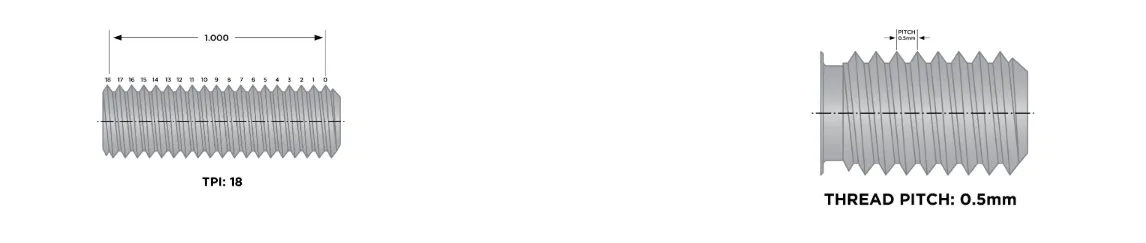
Regardless of the measurement system used, the size designation of nuts and bolts is always expressed as outside diameter (OD) followed by threads per inch (TPI). The designation may vary slightly between different measurement systems.
Inch Format
The size of an inch nut or bolt will be expressed as the thread size (a number between 1 and 12, or in inch increments) followed by threads per inch (TPI). If the diameter is less than 1/4 inch, the diameter will be expressed as a number between 0 and 12; the larger the number, the closer it is to 1/4 inch. When the diameter is equal to or greater than 1/4 inch, it will be expressed in inch increments.
|
Thread Size |
OD |
|
#10 - 32 |
0.19" |
|
#12 - 24 |
0.216" |
|
1/4" - 20 |
0.25" |
|
5/16" - 18 |
0.3125" |
TPI (Threads Per Inch) follows the diameter.
TPI refers to the number of threads per inch of thread length.
Example 1: #6-24 (#6 = outside diameter 0.138 inches; 24 = 24 threads per inch)
Example 2: 1/4"-28 (1/4 = outside diameter 1/4 inch; 28 = 28 threads per inch)
Metric Format
The thread size of a metric nut or bolt begins with the letter "M," followed by a number representing the thread diameter (in millimeters), and then the pitch.
Example: M4 x 0.7 (M4 = outside diameter 4 mm; 0.7 = thread pitch 0.7 mm)
The size designation of nuts and bolts sometimes indicates whether the thread is coarse or fine. Simply put, coarse threads are thicker with a larger thread pitch, while fine threads are thinner with a smaller thread pitch.
There are several abbreviations used to represent various thread types. Types:
Standard Coarse Thread
UNC: Uniform National Coarse Thread, equivalent to ISO metric threads.
UNRC: Uniform National Coarse Thread; "R" indicates "rolled" external thread, with a rounded root profile. They are fully interchangeable with UNC fasteners.
UNJC: Uniform National Coarse Thread, with an increased minor diameter and controlled root radius, distributing tensile strength over a wider area. Derived from military standard (MIL-S-8879), designed for high-stress applications. However, they are not interchangeable with other UNC fasteners.
Metric Coarse Thread
ISO metric threads only use the term "coarse thread."
Standard Fine Thread
UNF: Uniform National Fine Thread.
UNRF: Uniform National Fine Thread; "R" indicates "rolled" external thread with a rounded root profile. They are fully interchangeable with other UNF fasteners.
UNJF: Uniform National Fine Thread with an increased minor diameter. The diameter and controllable root radius allow tensile stress to be distributed over a larger area. They are derived from military standard (MIL-S-8879) and are designed for high-stress applications. However, they are not interchangeable with other UNF threaded fasteners.
Metric Fine Threads
ISO metric threads are often labeled "fine" or "extra fine".
Sometimes, you will see the same thread size listed twice, each time with a different pitch (TPI).
For example:
M2.3 x 0.45 vs. M2.3 x 0.4: They have the same diameter, but the first size has a larger pitch than the second, resulting in a greater distance between the threads.
#10-24 and #10-32: They have the same diameter, but the first size has a lower TPI (Thread PI) than the second, resulting in fewer threads per inch of thread length.
Because TPI and pitch are calculated differently, keep the following in mind:
Inch-sized threads: A higher TPI (threads per inch) indicates a finer thread because it contains more threads per inch of thread length.
Metric threads: A lower pitch indicates a finer thread because the spacing between the tips of each thread is smaller.
The specifications of nuts and bolts are governed by relevant standards, specifically those specific to their measurement systems.
Imperial Standards
If your nuts or bolts conform to any of the following standards, you are using imperial fasteners:
UTS: Unified thread standard for commonly used threads in the United States and Canada, including Unified National Coarse Thread (UNC) and Unified National Fine Thread (UNF).
ASME/ANSI — Specifies the thread characteristics of three universal unified threads, including: UN, UNR, and UNJ series fasteners.
SAE: A standard for specifying the number of threads per inch (N/A) for American (or standard) coarse and fine thread bolts, screws, pipe fittings, ports, and flange ports.
Metric Standards
For metric nuts and bolts, the most commonly used standards are:
ISO: Strict specifications for metric coarse, fine, and extra-fine threads developed by the International Organization for Standardization (ISO).
DIN: Standards developed by the German Institute for Standardization (Deutsches Institut für Normung, abbreviated as "DIN") applicable to commonly used thread types in Europe.
ASTM: The American Society for Testing and Materials (ASTM) standards cover both imperial and metric nuts and bolts. We will discuss how to identify the appropriate metrology system in the next section.
Sometimes, manufacturers engrave grooves on nuts and bolts to indicate the strength of the fastener. Different standards use different strength markings, but you are most likely to encounter a few.
Imperial Grade Markings
Imperial nuts conforming to SAE standards have longitudinal grooves inside a circle at the top; bolts have grooves extending outwards from the center on the head.

Metric Grade Markings
If a nut or bolt uses numbers instead of grooves to indicate its strength grade, it is a metric fastener. However, depending on the fastener standard, metric nuts may also display lines and dots between the circle and the side of the nut. These grooves on metric nuts are located outside the circle.

ASTM Grade Markings
You may also encounter bolts marked with a combination of alphanumeric characters, typically the letters "A," "B," or "F" and one to four numbers. This marking can appear alone or with grooves. This is the ASTM strength grade marking. If this mark is followed by a capital "M", it indicates that the fastener is metric. If there is no "M", it is an imperial fastener.
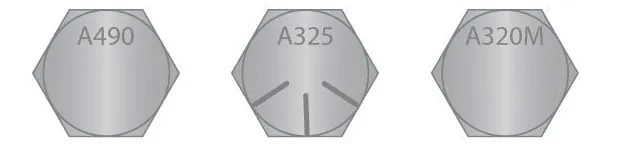
Although imperial and metric nuts and bolts have essentially the same function and physical properties, their dimensional designations differ. Dimensioning is indicated by key measurements, standards, and strength grades.
The biggest difference between imperial and metric nut and bolt dimensions lies in the definition of the measurement method. While each nut or bolt has its own measurement characteristics, the dimensions of all fasteners are measured in terms of thread diameter and threads per inch (TPI, or pitch).

Address:1177 Huanhu Road, Yuelu District, Changsha, Hunan, China
 WhatsApp
 WeChat