
 简体中文版
简体中文版

API 5L (American Petroleum Institute) is a widely accepted standard for steel pipes used in the transportation of natural gas and petroleum products. Among various pipeline manufacturing and welding processes, LSAW steel pipes are favored for their high quality and low cost, especially for high-pressure, long-distance oil pipelines, efficiently transporting oil and gas from production areas to consumption areas.
This article will detail the API 5L
standard, including the differences between PSL1 and PSL2, and the technical
advantages of LSAW steel pipes in large-scale energy projects.
The API 5L specification is primarily
designed for the transportation of natural gas and oil in the natural gas and
oil industry. It specifies the material and manufacturing requirements, testing
and inspection methods, and lengths for product analysis, testing, and
inspection for both seamless steel
pipes and welded steel pipes.
This standard aims to improve the safety,
reliability, and operational integrity of pipelines, which typically operate in
remote and complex terrain.
A key component of the API 5L standard is
the pipe strength classification system. Ratings are typically indicated by an
"X" followed by two or three digits (e.g., X52, X65, X70, X80).
The "X" is a historical
designation for modern high-strength pipes. The number following the
"X" indicates the minimum yield strength (MSI) of the pipe steel,
measured in kilopounds per square inch (ksi).
API 5L X52: Minimum yield strength of
52,000 psi.
API 5L X65: Minimum yield strength of
65,000 psi.
API 5L X70: Minimum yield strength of
70,000 psi.
Yield strength is an important engineering
parameter. It is the stress at which steel begins to undergo permanent
deformation. A higher MYS value means the pipe can withstand higher internal
pressure before yielding, and internal pressure considerations are a major
driving factor in any pipe design.
For project managers, engineers, and
procurement personnel, it is crucial to ensure that standard-compliant piping
materials and fittings are used for specific projects based on the correlation
between strength, corrosion resistance, and manufacturing requirements.
This standard is divided into two Product
Specification Levels (PSL): PSL1 and PSL2, which define different grades of
quality and testing requirements for natural gas and oil steel, respectively.
PSL1 (Product Specification Level 1): Basic
Quality Grade
PSL2 (Product Specification Level 2): High Reliability Grade
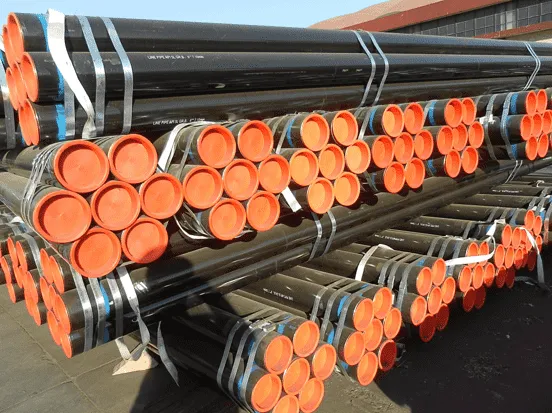
The most significant difference in the API
5L standard lies in the classification of PSL1 and PSL2, although both are used
for oil and gas pipelines. PSL2 has a higher quality grade and more stringent
requirements, making it essential for high-pressure, sulfur-containing, or
critical application environments.
Let's take a closer look at their main
differences:
The chemical properties of steel are
crucial to its performance. PSL2 has stricter restrictions on chemical
composition to improve pipe strength and weldability while reducing impurities.
Carbon (C): PSL2 has an upper limit on carbon content. This reduces hardness,
improves weldability, and increases yield strength.
Sulfur (S) and Phosphorus (P): PSL2 has
even higher limits on sulfur and phosphorus. Lowering sulfur and phosphorus
content improves the steel's properties and gives it greater resistance to
brittle fracture.
Carbon Equivalent (CE): The maximum carbon
equivalent required for PSL2 steel pipes is a practical standard for measuring
the weldability of the steel. Most PSL1 grade steel pipes do not have this
requirement.
Mechanical properties determine the
performance of the steel pipe under stress. PSL2 steel pipes have higher
mechanical property requirements to ensure superior performance under high
pressure and high strain.
Yield Strength and Tensile Strength: Both
PSL1 and PSL2 steel pipes specify yield strength and tensile strength. PSL2
steel pipes also specify (approximate) maximum strength requirements. This
"strength range" avoids the problem of unstable performance due to
excessive brittleness of the material.
Fracture Toughness: This is a crucial
indicator for different grades of steel pipes. All PSL2 grade steel pipes must
undergo a Charpy impact test (an indicator of material fracture toughness) and
have an impact performance rating specification to determine their ability to
resist crack propagation under low temperature or impact conditions. PSL1 steel
pipes do not require this test unless otherwise specified in the purchase
order.
The inspection and testing procedures for
PSL2 are more stringent, consistent with its use in critical applications.
Non-Destructive Testing (NDT): For PSL2
pipes, NDT is mandatory (inspection of the pipe body using a tapping rod
instead of an impact rod; see 12.8.3). For PSL1, NDT is not always mandatory
and is at the buyer's discretion.
Hydraulic Pressure Testing (Inspection):
All pipes, whether PSL1 or PSL2, must undergo a hydraulic pressure test to
detect leaks, but only PSL2 pipes have higher testing standards, more stringent
requirements, and require more comprehensive documentation.
Traceability: PSL2 pipelines require a
certain level of traceability, while PSL1 pipelines do not, although PSL2
traceability is achieved through document transfer rather than steel
consistency. This ensures comprehensive accountability and strict quality
control.
PSL2 has more stringent overall quality
control and manufacturing processes.
Weld Repair: PSL2 prohibits repairs to the
pipe body and welds; PSL1 also prohibits repairs to welds and pipe bodies
unless relevant tests have been conducted by the steel mill.
Steel Origin: The stringent chemical and
mechanical quality requirements of PSL2 typically mean that the steel must
originate from a different steel mill than the one that produced the pipeline.
In summary, PSL1 provides a standard
quality level for general-purpose pipelines, while PSL2 offers a higher level
of product with superior chemical purity, mechanical reliability, and proven
toughness, making it an essential choice for acidic environments, high-pressure
applications, and offshore pipelines.
Longitudinal Submerged Arc Welding (LSAW)
steel pipes are ideal for projects conforming to API 5L standards, especially
for high-grade steel pipes and PSL2 requirements.
Large Diameter and Thick Wall: LSAW is one
of the few methods capable of producing ultra-large diameter (up to 64 inches
or 1626 mm) and extremely thick-walled steel pipes. This is primarily due to
advanced manufacturing technologies such as the JCOE process, making it crucial
for high-volume, high-pressure transport.
High Strength and Uniformity: This process
allows the use of high-strength steel plates, facilitating the use of
high-grade materials such as X65/X70/X80, and produces uniform, high-quality
welds, ensuring consistent mechanical properties along the length of the pipe.
Excellent Dimensional Accuracy: LSAW steel
pipes offer excellent straightness, roundness, and dimensional control, which
are crucial for field welding and installation.
Long-distance oil and gas pipelines:
Require the efficient and safe transport of large quantities of oil and gas
over thousands of kilometers.
Offshore pipelines: Pipelines must
withstand enormous external pressure, corrosive seawater, and dynamic loads.
High-pressure gas storage and
transportation: Includes compression stations and trunk pipelines requiring the
highest integrity.
If the project has the following
characteristics, PSL2 is recommended directly:
High design pressure;
Sulfur content (sour service);
Low-temperature environment;
Offshore pipeline;
Densely populated areas;
Large-diameter trunk lines;
X65 and above steel grade.
Scenarios where PSL1 can be considered:
Low-risk areas;
Normal temperature environments;
Low-pressure transportation;
Cost-sensitive projects;
Non-critical pipelines.

Address:1177 Huanhu Road, Yuelu District, Changsha, Hunan, China
 WhatsApp
 WeChat